
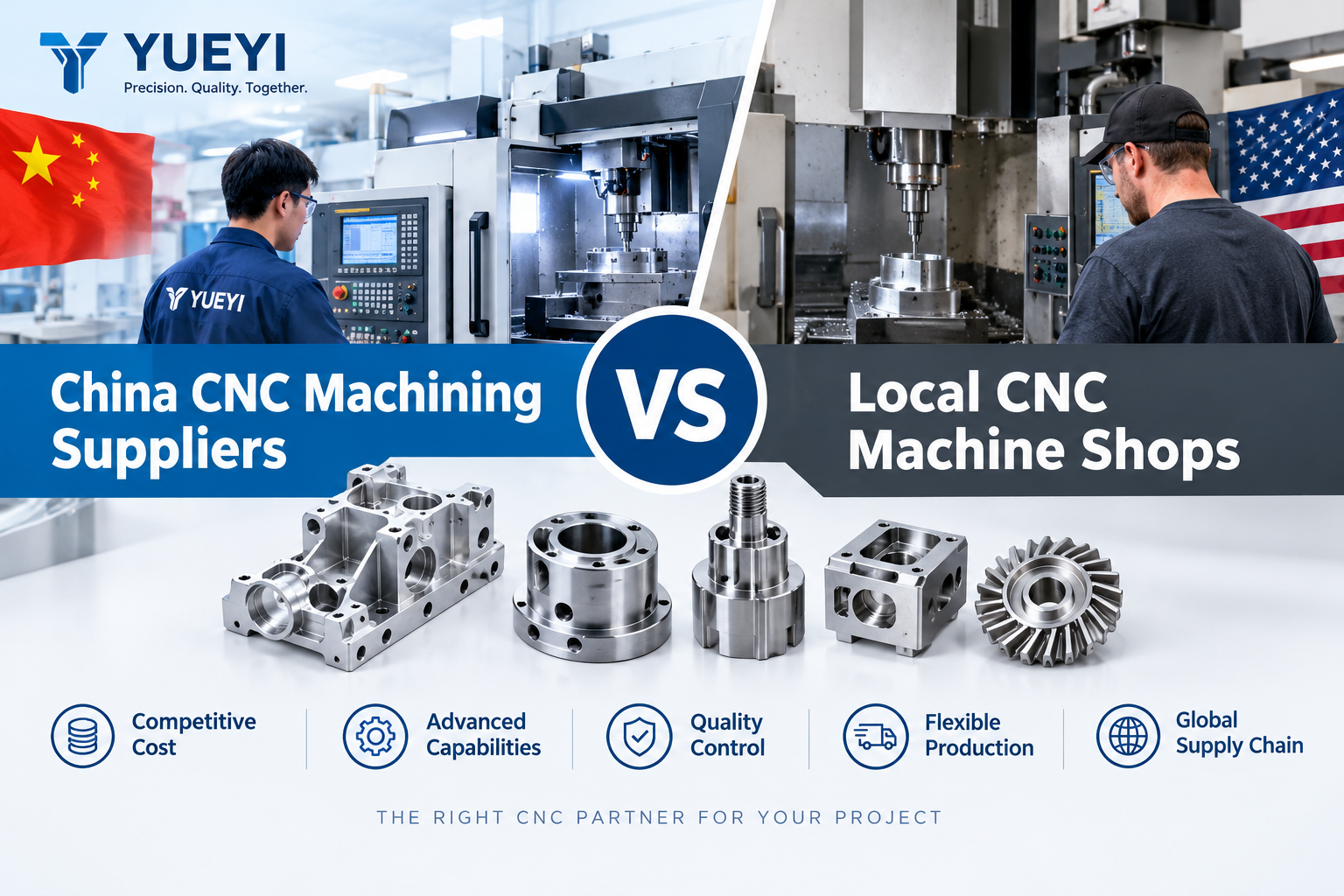
When you need custom precision parts, one question appears early: should you work with a local machine shop, or with China CNC machining suppliers? The answer shapes your cost, lead time, inspection evidence, and how smoothly a project moves from drawing to delivered parts.
For years the decision was treated as simple. Local shops were seen as fast and easy to talk to, while China CNC machining suppliers were associated mainly with lower prices. Today the picture is more nuanced. A mature manufacturing ecosystem in China now covers machining, inspection, surface treatment, heat treatment, tooling, assembly, and logistics. At the same time, local shops remain the right choice for some urgent or regulated work.
China CNC Machining Suppliers vs Local Shops: What Really Changes
The real difference is not a country label. It is how each supplier handles scope, communication, and risk. China CNC machining suppliers often coordinate materials, machining, finishing, and inspection under one roof, which reduces the number of handoffs your team must manage. A local shop may offer faster face-to-face contact but rely on outside partners for finishing or special processes.
Neither option is universally better. The right choice depends on part complexity, quantity, tolerance requirements, delivery schedule, and the total landed cost rather than the hourly machine rate alone. Understanding where China CNC machining suppliers add value helps you decide which projects benefit from international sourcing.
1. Competitive Total Manufacturing Cost
One reason buyers evaluate China CNC machining suppliers is cost efficiency. The advantage is rarely just a lower hourly rate. A mature supply chain for materials, cutting tools, fixtures, heat treatment, finishing, inspection, packaging, and logistics can lower the cost of a finished component.
Common engineering materials such as aluminum 6061 and 7075, stainless steel 303, 304 and 316, carbon steel, tool steel, titanium, copper, brass, and engineering plastics are widely available. Access to several material sources makes it easier to balance technical requirements against budget. China CNC machining suppliers that work across these materials can often suggest a practical grade rather than a default choice.
Custom fixtures and production tooling are also easier to source within an established industrial network. Jigs, gauges, and machining aids can be designed and built locally instead of being sent to unrelated vendors. Coordinating surface treatment and secondary operations through one partner reduces transport and scheduling problems. When comparing China CNC machining suppliers, evaluate the total landed cost rather than the machining rate in isolation.
2. Advanced CNC Machining Capabilities
The capabilities of China CNC machining suppliers have developed significantly. Professional manufacturers operate multi-axis machining centers, CNC turning centers, CMM inspection systems, wire EDM machines, and grinding equipment. For complex 3D parts, five-axis machining can reduce the number of setups and lower repositioning error.
Fewer setups mean fewer fixtures, less setup time, and less dimensional variation between operations. This matters when a component has features on several faces that must relate to one another. A supplier with the right equipment can hold those relationships more consistently than a shop that must re-clamp the part repeatedly.

3. From Prototypes to Production Parts
A product rarely jumps directly from CAD to mass production. A typical path runs from prototype to design validation, then small batch, then production. Changing suppliers at every stage introduces engineering and quality risk, because differences in machining method, tooling, inspection, or material source can affect consistency.
Working with one manufacturer across these stages carries early feedback into later production. China CNC machining suppliers that support prototypes and volume orders can keep the process stable as quantities grow. This is useful for robotics components, automation equipment, drone parts, aerospace-related applications, industrial machinery, medical equipment, and custom mechanical parts.
4. Precision Inspection and Quality Control
Cost is only part of sourcing. For precision components, repeatability and inspection capability matter just as much. A professional supplier should control the whole process rather than produce parts and check a few dimensions at the end. Depending on the component, inspection may include CMM measurement, dimensional checks, thread and surface roughness inspection, hardness testing, material verification, first article inspection, and sampling.
China CNC machining suppliers with in-house CMM capability can provide reports before parts leave the factory, which gives international buyers useful evidence. For guidance on how a drawing should define these requirements, see our guide to CNC machining tolerances, fit, and function.

5. One Partner for Multiple Processes
A CNC component often needs more than machining: heat treatment, grinding, surface treatment, inspection, marking, and packaging. When each step goes to a different vendor, your team must coordinate multiple quotations, delivery schedules, quality issues, transport, and technical changes. A capable manufacturing partner can coordinate these as one project.
This integration is one of the practical reasons companies shortlist China CNC machining suppliers for complex parts. It reduces the number of parties responsible for a finished component and makes it clearer where a problem originates. Buyers who want to understand the quoting side can review our CNC machining RFQ checklist before requesting prices.
When Does a Local CNC Shop Make More Sense?
China CNC machining suppliers are not automatically right for every project. If you need a replacement part within 24 to 48 hours for a machine breakdown or urgent test, a local shop has an advantage because geographical proximity matters more than unit price.
Some projects also need engineers and machinists to work side by side, modifying a setup on site or testing assemblies together. Defense-related work and other regulated applications may require domestic manufacturing or specific certifications. In these cases, check regulatory requirements before selecting an overseas supplier. For international orders, clarify the delivery rule, named place, and edition with China CNC machining suppliers so responsibilities are unambiguous.
China CNC Machining Suppliers Compared with Local Shops
| Factor | Local CNC Shop | China CNC Machining Suppliers |
|---|---|---|
| Prototype and small batch | Suitable | Suitable |
| Medium volume | Depends on capacity | Often highly flexible |
| Manufacturing cost | Generally higher | Often more competitive |
| Communication | Convenient, often on site | Remote but structured |
| Urgent 24–48 hour jobs | Advantage | International logistics required |
| Five-axis capability | Depends on the shop | Widely available |
| Material sourcing | Depends on local network | Broad supply chain |
| Finishing and inspection | May need subcontracting | Easier to coordinate |
| International shipping | Not required | Required |
| Scalability | Depends on shop size | Strong for qualified manufacturers |
The table shows why there is no universal answer. The right supplier depends on your project, and China CNC machining suppliers should be judged on demonstrated capability rather than a country-wide assumption.
What to Check Before Choosing China CNC Machining Suppliers
Instead of choosing on price alone, evaluate a short list of factors. First, confirm that the supplier owns or controls the equipment your part needs, from three-axis milling and turning to five-axis machining, wire EDM, grinding, and CMM inspection. Second, ask about experience with your specific material, since aluminum behaves very differently from hardened tool steel, titanium, or engineering plastics.
Third, match inspection equipment to your drawing tolerances. Fourth, ask how the supplier plans to manufacture the part, including material, method, critical dimensions, tolerances, finishing, heat treatment, and packaging. Fifth, test communication: a good partner answers technical questions, flags manufacturing risks, and gives production updates. On drawing preparation, an independent technical drawing guide for CNC machining explains why the drawing and model must agree, although its platform conventions are supplier specific.
China CNC machining suppliers that pass these checks are usually straightforward to work with. Those that cannot describe their process in writing are harder to trust, regardless of how attractive the quotation looks.
Why Choose Yueyi Among China CNC Machining Suppliers
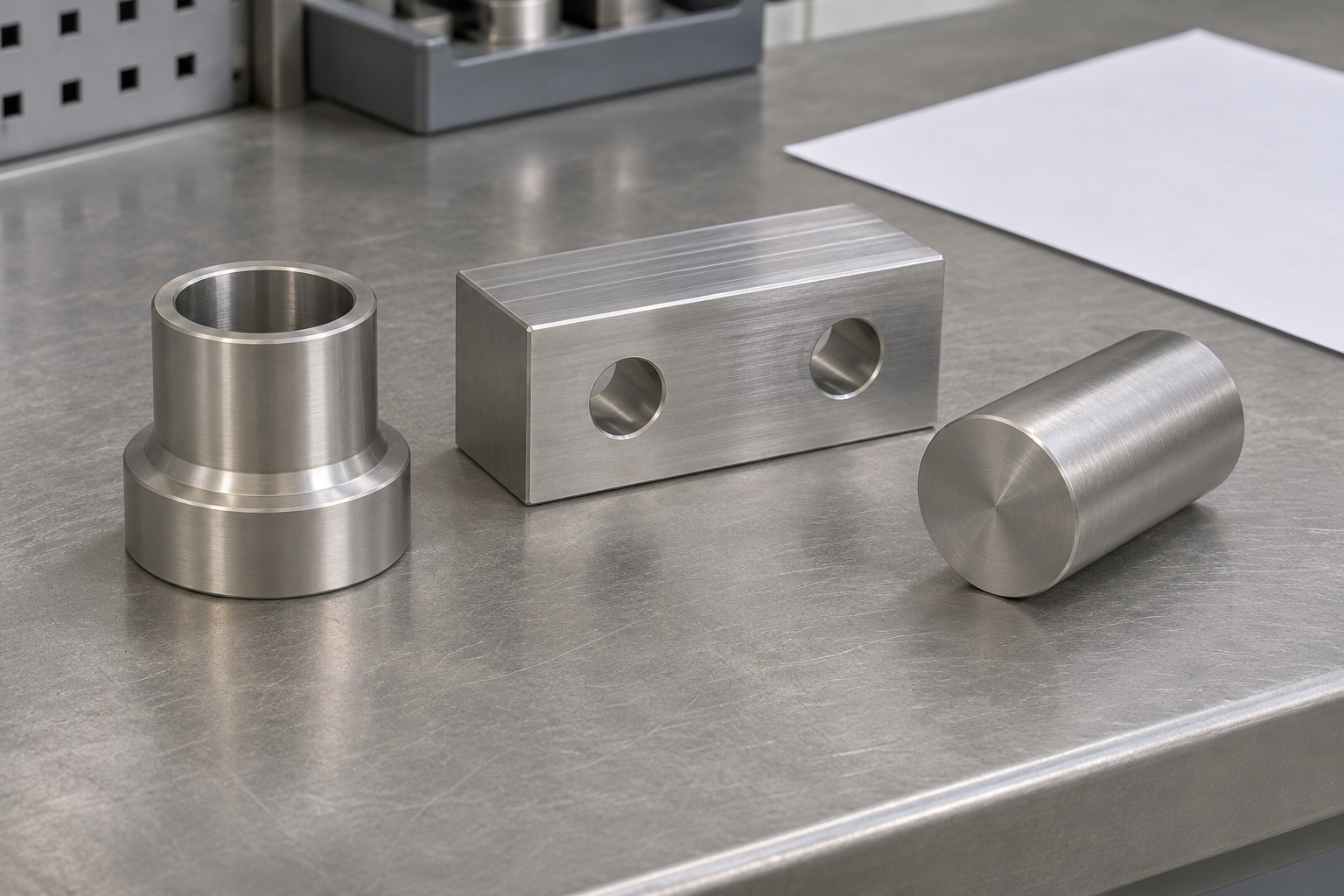
Yueyi Precision Technology is a precision manufacturer based in Dongguan, Guangdong, China. Our services cover five-axis CNC machining, CNC milling, CNC turning, precision machining, prototyping, fixtures, wire cutting, surface finishing, inspection, and production parts. Our work includes components for humanoid robots, drones, automation equipment, aerospace-related applications, medical equipment, industrial machinery, and marine equipment.
For complex parts, our engineering team reviews drawings and 3D models before production to identify potential manufacturing issues. The process runs from drawing review and engineering analysis through machining, secondary operations, CMM inspection, final inspection, packaging, and delivery. Like other established China CNC machining suppliers, we aim to provide stable quality, reliable delivery, engineering support, and competitive total cost rather than the lowest headline price.
You can explore our CNC machining services and turn-milling capability, then send your drawings for review.
Final Thoughts on China CNC Machining Suppliers
Choosing between a Chinese supplier and a local shop depends on your priorities. A local supplier suits extremely fast turnaround, frequent on-site collaboration, or domestic regulatory needs. China CNC machining suppliers suit projects that value competitive cost, advanced machining capability, flexible volumes, integrated secondary processes, and a mature supply chain.
The most important point is to evaluate the supplier rather than judging an entire region by price. A reliable partner demonstrates real capability, experienced engineers, appropriate inspection equipment, stable quality control, clear communication, and consistent delivery. When those basics are in place, China CNC machining suppliers can be a dependable extension of your engineering and purchasing team from prototype through production.
Not sure which route fits your part? Review our RFQ checklist, compare the delivered scope, and request an engineering review.
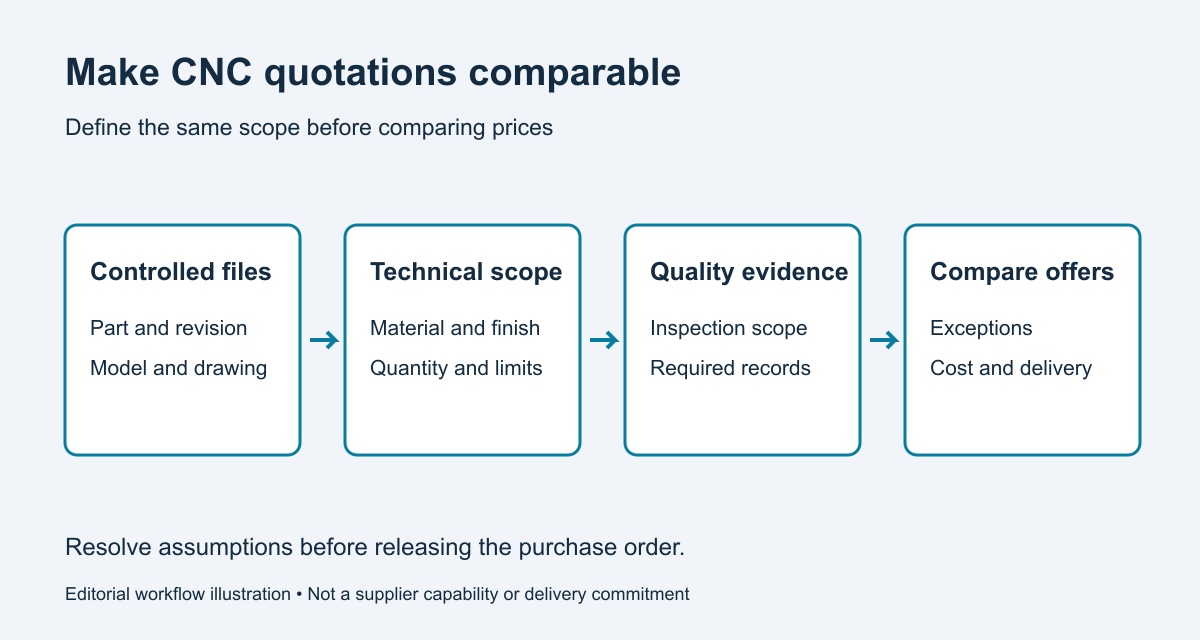
How to Request Comparable Quotes from China CNC Machining Suppliers
A quotation is only useful when two suppliers have priced the same scope. Before you request prices, fix the part number, revision, units, material grade, quantity, and delivery requirement in one controlled package. Send the model and the drawing together, and state which document governs if they disagree. China CNC machining suppliers that receive a clear package can respond with a realistic process and price instead of a guess.
Ask each bidder to list its assumptions. An alternative material, a relaxed tolerance, a different finish, or an excluded operation is a proposal to review, not an approved change. Keep exceptions in one log and share the answer to each technical question with every bidder. If engineering issues a new revision during bidding, reissue the package and request a revised price so no one quotes from an outdated file.
Separate one-time charges from recurring ones. Programming, fixtures, and special tooling may be charged once or spread across a batch, and the lowest unit price is not always the lowest cost for the quantity you plan to buy. Request separate prices for prototypes, an initial batch, and likely repeat volumes, and label uncertain future demand as a forecast rather than a commitment. When you compare the delivered scope on the same rows, differences between China CNC machining suppliers become easy to see.
Managing Communication and Engineering Changes During Production
International sourcing works best when communication is structured. Agree who owns technical approval, who signs off on exceptions, and how quickly each side will respond to a drawing question. China CNC machining suppliers that give a single point of contact for engineering and order progress are usually easier to work with than those that route every question through sales alone.
Engineering changes are the most common source of cost and schedule disputes. A change to a tolerance, material, surface treatment, or inspection requirement should be recorded against a new revision and acknowledged before it is implemented. A verbal instruction may seem faster, but it creates uncertainty about what was actually built and what should be inspected.
Set a regular update rhythm for longer projects so problems surface early. Ask for confirmation of the process route, the inspection stage, and any hold point before the batch proceeds. When a supplier flags a manufacturability risk, treat it as useful information rather than an obstacle; an early design adjustment is far cheaper than rework after parts have shipped.
Total Landed Cost: What Buyers Often Miss
The unit price is only one line in the real cost of a part. Freight, duties, import handling, and the time a shipment spends in transit all matter, especially when a schedule slips and an air shipment replaces sea freight. China CNC machining suppliers can quote a competitive part price, but the buyer still needs to model the full delivery cost before awarding an order.
Quality cost belongs in the same calculation. A cheaper part that fails inspection, needs rework, or causes an assembly delay can cost far more than a well-controlled component from a slightly higher quote. Inspection reports, material certificates, and a clear acceptance criteria reduce this risk by making the delivered condition explicit.
Inventory is a third factor. Lower prices at larger volumes are attractive only if the business needs those quantities and can store them without tying up cash. A balanced view combines part price, one-time charges, logistics, quality evidence, and inventory cost. Measured this way, China CNC machining suppliers can be compared fairly with local shops on the basis of delivered value rather than a single number.
Building a Long-Term Relationship with Your Supplier
Most sourcing decisions are revisited after the first order. A supplier that delivered one good batch has shown it can make the part, but a durable relationship depends on how it handles the next revision, a rush request, or a quality question months later. China CNC machining suppliers that keep records of drawings, processes, and inspection results can repeat a part consistently and quote a follow-up order on the same basis.
Share forecast information where you can, even when it is not a commitment. A supplier with a visible pipeline can reserve capacity and material more effectively, which helps both sides plan. In return, ask for transparent explanations when a price or lead time changes rather than assuming the worst.
Treat the first article, the inspection record, and the agreed exceptions as one package. When a later order differs, that record shows whether the cause was material, setup, or measurement. Over time, this discipline turns a series of transactions into a stable supply arrangement, and it is the practical difference between finding a vendor and choosing a partner.
Frequently Asked Questions
Are China CNC machining suppliers suitable for prototype work? Yes, when the supplier has engineering support and can carry feedback from the prototype into later production. Ask whether the same process and inspection route will be used as volumes grow.
How do I protect my design when sourcing overseas? Share a controlled drawing that defines requirements, keep a revision log, and agree in writing that material or tolerance changes need approval. Clear scope protects both parties.
What inspection evidence should I request? Ask for a report on the characteristics that control fit and function, measured against the agreed revision. A sample report is evidence about that sample, not a guarantee of every later part.
How should I compare two quotations fairly? Put both offers on a common sheet with rows for material, revision, quantity, one-time charges, inspection, finishing, packaging, delivery, and payment terms. Mark any excluded operation clearly. If one supplier has assumed a looser tolerance or a different finish, that is not the same offer, and the difference should be resolved before you compare numbers.
Can a supplier manage both prototypes and production? Many can, and it is worth asking because keeping one partner across stages preserves engineering feedback and reduces variation. Confirm that the same process route and inspection approach will be used as volumes increase, and agree in writing what changes when the quantity changes.