
Two suppliers quote the same CAD model. One includes material traceability, a dimensional report, and protective packaging. The other prices machined parts with basic inspection and leaves shipping to the buyer. The lower unit price does not tell you which offer costs less for the delivery you actually need.
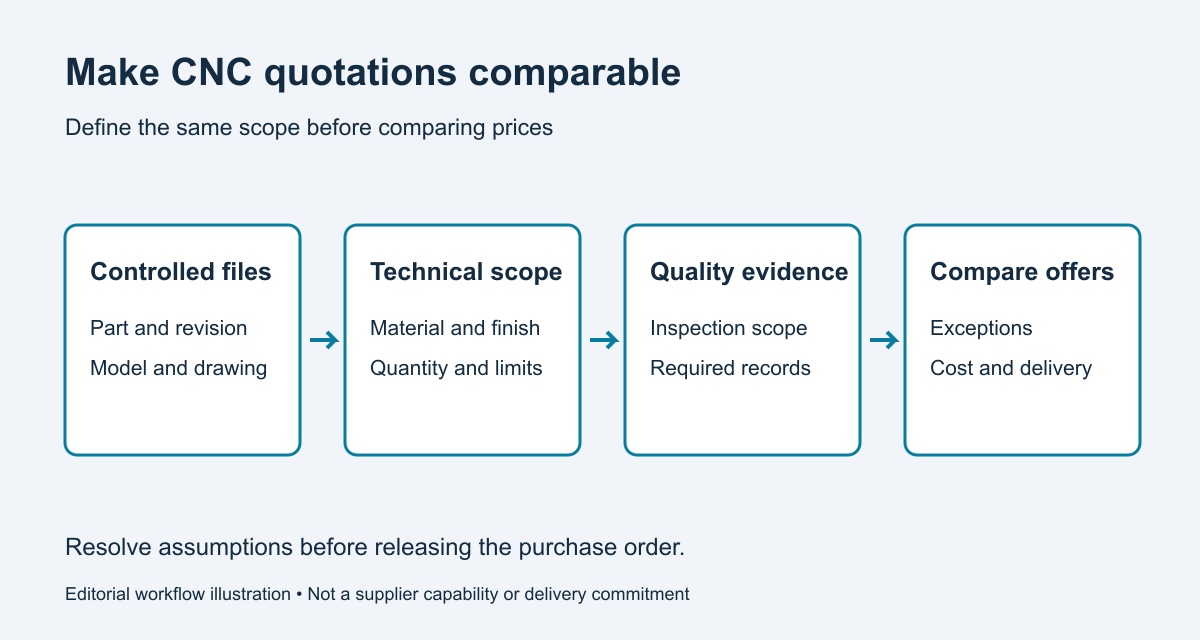
Before comparing the numbers, check what each supplier has agreed to deliver. A CNC machining RFQ, or request for quotation, should make that scope explicit. Engineering owns the technical baseline; procurement needs the same baseline in every offer. The following checklist is designed to expose gaps while there is still time to resolve them.
What files should a CNC machining RFQ include?
Start with a package that identifies the part number, revision, units, requested quantity, and required delivery date. Include the 3D model and a controlled drawing where tolerances, threads, finishes, or other requirements need explicit definition.
The model communicates geometry, while the drawing can communicate requirements that geometry alone does not fully describe. Protolabs Network’s technical drawing guide explains this complementary role. [1] Its platform conventions are supplier-specific; your RFQ should state your own document requirements rather than assume every supplier follows the same workflow.
Check that the drawing and model agree. If they conflict, resolve the difference before order placement. A document-precedence note can help interpret a package, but it does not make a known design conflict safe to ignore.
If engineering issues a revision during bidding, distribute the updated package to every bidder and request a revised quotation. Comparing prices based on different revisions creates a false comparison.

Specify the material grade and traceability you need
“Aluminum” or “stainless steel” is rarely enough to define a production material. State the required grade, applicable material specification, and condition or temper where relevant. Identify any restrictions on substitution.
Also define the evidence required at delivery. A supplier’s statement of conformity and a material producer’s certificate serve different purposes. If traceability to a material heat or lot is necessary, request it explicitly and confirm how the supplier will preserve the link through production.
Do not demand extra documentation automatically. Ask what the product, customer, or quality system requires. Unnecessary paperwork can consume time, while missing traceability can make otherwise acceptable parts unusable for the intended order.
Separate critical requirements from quotation assumptions
List the features or requirements that deserve specific feasibility confirmation. These may include a locating interface, a deep bore, a surface treatment restriction, or a cosmetic face. Reference the controlled drawing rather than copying dimensions into multiple documents that can drift apart. For the drawing review, see our guide to CNC machining tolerances, bore position, and inspection.
Ask each supplier to identify exceptions and assumptions in a dedicated section of the quotation. An alternative material, relaxed tolerance, or different finish is a proposal to review, not an approved change.
A short clarification log is useful: record the question, agreed answer, affected document, and approval. Incorporate accepted technical changes into the controlled package before releasing the order.
Example RFQ parameters for a machined bracket
The following is an illustrative purchasing package for an aluminum mounting bracket. The values describe a hypothetical request, not a completed customer project, a supplier quotation, or a universal drawing specification.
| RFQ field | Example entry | Clarification needed |
|---|---|---|
| Part identity | BRK-001, revision B | Model and drawing must show the same revision |
| Material | 6061-T6 aluminum | Identify the material specification and required evidence |
| Quantities | 10 prototypes; separate quote for 100 parts | Separate setup charges and repeat-order assumptions |
| Part envelope | 80 × 50 × 20 mm | Overall size does not describe all machining complexity |
| Locating feature | 10.000–10.018 mm bore, as specified on drawing | Confirm final-condition limits and location controls |
| Surface Treatment | Quote as-machined and anodized options separately | Agree masking and final dimensional requirements |
| Inspection | Initial sample report on marked critical features | List measured characteristics, methods, and approval hold point |
Do not copy these numbers into a live RFQ without an engineering review. For example, the bore limits do not define its position relative to the mounting face, and the overall envelope says nothing about thin walls or tool access. The controlled drawing must supply the missing requirements.
Quote the quantities you actually plan to buy
Provide separate quantities for prototypes, an initial production batch, and likely repeat orders when these are known. Ask which charges are one-time and which recur.
Setup, programming, workholding, and special tooling can affect the price structure. A lower unit price at a larger quantity is useful only if the business needs that quantity and can manage the inventory. Do not assume the prototype price predicts repeat production cost.
Where future demand is uncertain, label it as a forecast. A forecast and a committed purchase quantity create different planning conditions for both parties.
What inspection report should you request for CNC parts?
“Inspection included” leaves several questions unanswered. Which characteristics will be measured? How many parts will be checked? Will the buyer receive numerical results, a pass/fail statement, or a formal report?
For important features, agree the measurement approach and reference setup. If the order requires approval of an initial sample before the remaining batch proceeds, define that hold point and allow time for the buyer’s review.
A sample report establishes evidence about the inspected sample. It does not, by itself, demonstrate long-term process capability or certify every later part. Keep those acceptance concepts separate when discussing production assurance.
Define finishing, edge condition, and packaging
Specify the finish by its required process or governing specification, with applicable color, appearance, masking, and dimensional requirements. State whether critical dimensions apply to the final delivered condition.
For edges, identify restrictions that matter to assembly or handling. A broad instruction to remove burrs may need more detail around a sealing edge, a precision intersection, or a feature that must remain sharp.
Packaging should reflect the risks. Precision faces may need protection from contact, and individually identified parts may need labels linked to the order or inspection records. Describe the required outcome and ask the supplier to confirm the packing approach.
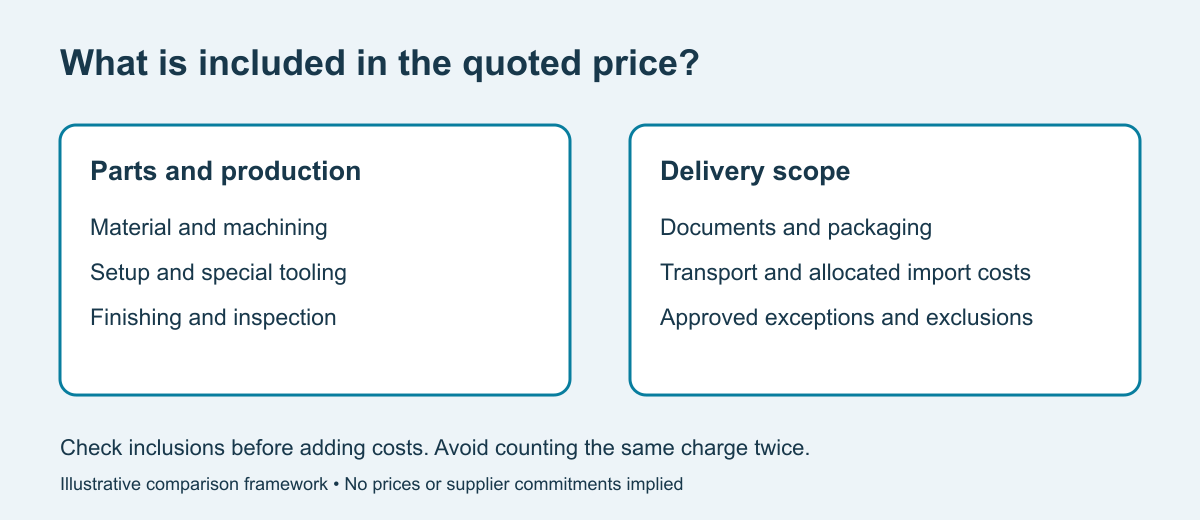
Compare delivered scope, then compare price
Use a comparison sheet with the same rows for every quotation:
| Item | What to establish before award |
|---|---|
| Technical baseline | Same part number, revision, material, and approved exceptions |
| Quantity | Same batch size and separate pricing for other volumes |
| Non-recurring charges | Programming, fixtures, tooling, and their reuse conditions |
| Quality evidence | Certificate, traceability, inspection scope, and report format |
| Finishing and packaging | Included operations, final-condition requirements, and protection |
| Delivery | Production lead time, approval holds, transit, and delivery location |
| Commercial basis | Currency, payment terms, quotation validity, and shipping allocation |
For international purchases, specify the agreed Incoterms rule, named place or port as appropriate, and edition. The International Trade Administration’s Incoterms overview explains how these rules allocate delivery responsibilities, costs, and risk. They do not replace the complete sales agreement. [2]
A practical comparison can start with quoted parts, one-time charges, required extras, and transport or import costs allocated to the buyer. Keep estimated costs marked as estimates, and check that the same cost has not already been included elsewhere in the quotation.
CNC machining RFQ email template
The following is an illustrative template, not a completed order:
Please quote part [number], revision [revision], at quantities [quantities]. Use the attached controlled model and drawing. Confirm the specified material and finish, identify all technical exceptions, and itemize one-time charges. Include [required quality documents], [packaging requirements], production lead time, and the proposed shipping basis to [destination]. Do not substitute material or change drawing requirements without written approval. State any clarification needed before production.
Before award, close the exception list and confirm the final document revision. If a quote says “standard inspection” or “shipping extra,” ask for the missing detail before signing the order. A short written clarification is much easier to resolve than a rejected shipment.
Ready to prepare a request? Review YUEYICNC CNC machining services and send your drawing, quantity, material, and delivery requirements.
References
[1] Protolabs Network — How to prepare a technical drawing for CNC machining
[2] International Trade Administration — Know Your Incoterms