
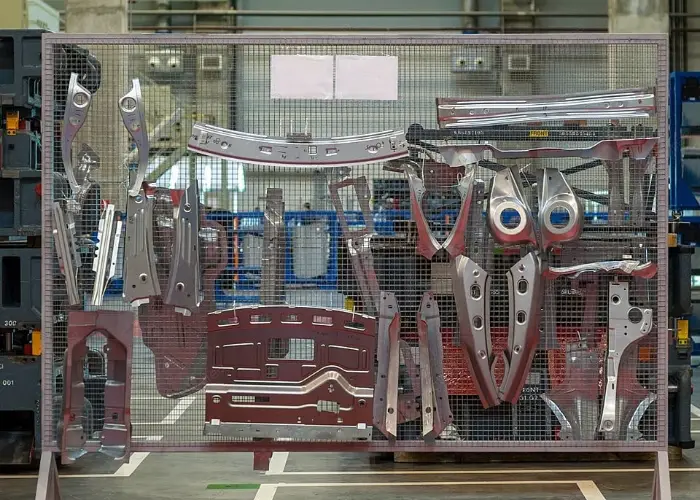
Automotive metal stamping is one of the foundational manufacturing technologies in the vehicle industry. It shapes flat sheet into precise, high-strength components through blanking, bending, embossing, and hot stamping. Stamped parts make up a large share of a vehicle’s metal content, and automotive metal stamping is central to both conventional and electric vehicle production.
The core principle is consistent across vehicle types, but materials, structural design, performance standards, and process specifications differ sharply between internal-combustion and electric vehicles. Lightweighting, efficiency, safety, and thermal management drive those differences. This guide explains what automotive metal stamping delivers in each case and how the processes are evolving.

The Role of Automotive Metal Stamping in ICE Vehicles
For decades, automotive metal stamping has supported the efficiency and structural reliability of gasoline and diesel vehicles. Complex powertrains, including engines, fuel tanks, exhaust systems, and transmissions, define the requirements for stamped parts: structural rigidity, vibration resistance, heat resistance, and cost-effectiveness.
The most common stamped parts fall into three groups. Body exterior and structural panels, such as doors, hoods, roofs, fenders, and frame reinforcements, use low-carbon and conventional high-strength steel to balance formability, surface finish, and crash safety. Chassis and powertrain parts, including suspension brackets, engine mounts, and cross beams, need fatigue resistance for long-term vibration and load. Functional auxiliary parts, such as fuel tank shells and exhaust brackets, focus on corrosion resistance and dimensional stability.
Conventional automotive metal stamping relies on mature, high-volume processes. Standard cold stamping with ordinary steel meets cost and production targets, and a long history of iteration has produced a standardized system with consistent quality and low unit cost.
EV Automotive Metal Stamping: New Requirements
Electric vehicles have reshaped automotive metal stamping. EVs remove the engine and exhaust but add battery packs, electric motors, and high-voltage systems. Stamped component design and process standards have changed with them.
EV design centers on two goals: lightweighting to extend range, and safety and thermal stability to protect electrical systems. Manufacturers widely adopt advanced high-strength steel, ultra-high-strength hot-stamped steel such as 22MnB5, and lightweight aluminum alloys. These reduce body weight while preserving strength, which improves energy efficiency and battery life.
EVs also need stamped parts that do not exist in conventional vehicles. Battery housing shells, tray reinforcing beams, motor mounting brackets, and thermal-management structures demand tight dimensions, sealing performance, and thermal fatigue resistance. A battery tray must resist deformation in service and isolate temperature changes to keep the pack safe. Electrical steel stamping for motors requires fatigue control under high temperature and load. This is where automotive metal stamping faces its most demanding work.
Key Process Differences Between EV and ICE Stamping
Different performance needs produce different processes. The comparison below summarizes how automotive metal stamping changes between conventional and electric vehicles.
| Aspect | ICE vehicles | Electric vehicles |
|---|---|---|
| Primary materials | Mild and conventional high-strength steel | AHSS, hot-stamped steel, aluminum |
| Forming method | Cold stamping | Hot stamping and forming simulation |
| Design priority | Cost and standardized volume | Lightweighting and thermal safety |
| Special parts | Powertrain and exhaust brackets | Battery housings, trays, motor mounts |
| Quality focus | Consistency and fatigue resistance | Tolerance, flatness, sealing |
High-strength and aluminum grades have less formability and more springback, which requires tighter process control and better die design. Hot stamping heats the sheet, forms it, and quenches it rapidly, solving the forming difficulty of high-strength steel while reaching very high tensile strength. Computer simulation has become standard for designing dies and predicting defects. Our fit and function guide explains how to define which features need tight control.

Quality Control in Automotive Metal Stamping
Battery and motor parts have stricter tolerance, flatness, and stability requirements than conventional stamped parts. A small dimensional deviation can affect battery assembly or electrical safety. Automotive metal stamping for these parts therefore needs higher-precision dies, closer process monitoring, and more rigorous finished-part testing.
In-process checks, first-article inspection, and statistical control help catch die wear or process drift before defects accumulate. For safety-critical components, documented evidence is part of the delivered value. Teams that also need machined components can review our CNC machining services to plan the full route.
Future Trends in Automotive Metal Stamping
As the industry moves toward electrification and intelligence, automotive metal stamping continues to evolve. Lightweight material forming will improve through new hot-stamping die steels and aluminum pre-hardening technologies, raising quality and efficiency for high-performance parts.
Intelligent manufacturing, built on simulation and precision die technology, is moving toward full-process digital control that reduces cost while improving consistency. For conventional vehicles, stamping will keep focusing on cost and standardized production while adopting lightweight methods to meet fuel and emission targets. For EVs, customized precision stamping for battery and electrical systems is the main development direction.
Technical Resources
1. SAE Mobilus — stamping process research on electrical steel fatigue for EV motors.
2. Atlantis Press — research on high-performance hot stamping die steel.
3. De Gruyter — computer simulation in die and stamping process design. An independent overview of technical drawing preparation also explains how clear requirements reduce stamping errors.
Frequently Asked Questions
Why do EV stampings differ from ICE stampings? EVs prioritize lightweighting and thermal safety, so they use stronger, lighter grades and add battery and motor structures.
What is hot stamping? The sheet is heated, formed, and quenched to reach very high strength, which is useful for safety-critical EV parts.
Which materials dominate automotive stamping? Mild and high-strength steel for conventional vehicles; advanced high-strength steel, hot-stamped steel, and aluminum for EVs.
Typical Components and Their Requirements
Understanding automotive metal stamping is easier when parts are grouped by function. Body panels demand surface quality and dimensional repeatability, because visible surfaces and assembly gaps are judged closely. Structural members demand strength and crash performance, while powertrain and battery parts demand fatigue resistance and, in EVs, sealing and thermal stability.
Body-in-white structures include pillars, rails, crossmembers, and reinforcements formed from stamped sheet and joined by welding. Each must locate accurately so the assembled body meets dimensional targets. A die that drifts can produce parts that fit poorly, which slows the line and affects finish.
Battery enclosures illustrate the stricter EV requirements. A tray must support the pack, resist intrusion, seal against moisture, and manage heat. These functions may be spread across several stamped pieces with different grades and thicknesses, joined into one assembly.
Motor laminations are another specialized product. They are stamped from electrical steel in very high quantities, and their fatigue performance and magnetic behavior depend on the material and the stamping process. Burr control and edge quality matter because they affect stacking and motor efficiency.
Material Selection in Practice
Mild steel remains economical for many conventional parts because it forms easily and costs less. Conventional high-strength steel adds strength for structural members without a large cost penalty. Advanced high-strength steel and hot-stamped grades serve safety-critical areas where weight and strength both matter.
Aluminum reduces mass but forms differently from steel. It has lower springback in some conditions but is more sensitive to cracking in tight radii, and it needs separate tooling considerations. Joining aluminum to steel also requires attention to corrosion and process compatibility.
Coated steels are common in automotive work because corrosion protection is built into the material. A coating can affect tool wear and surface finish, so the die and lubrication plan should be selected with the coating in mind. Specifying the exact grade and coating at the request stage avoids an incorrect substitution.
Design for Stamping
Good design makes automotive metal stamping more repeatable. Radii should be large enough for the material to form without cracking, and features should be arranged so the part can eject from the die. Deep draws and undercuts may need additional operations and should be flagged early.
Tolerances should be set by function. Assembly interfaces and sealing faces deserve tighter control, while hidden or non-functional features can use general tolerances. Applying tight values everywhere raises die cost and inspection effort without improving the part.
Simulation is now standard for complex parts. It predicts thinning, springback, and wrinkling before steel is cut for the die, reducing tryout time and defects. Buyers benefit when a supplier uses simulation as part of the normal process rather than as a reaction to a failed tryout.
Tooling Life and Production Planning
Automotive programs run for years, so tooling life matters. Dies are built with replaceable inserts and hardened sections in high-wear areas, and they are maintained on a schedule. Planning for maintenance prevents gradual dimensional drift that would otherwise produce nonconforming parts.
Production volumes influence die design. A high-volume program justifies premium tool steel and coatings, while a lower-volume run may use simpler tooling. Declaring the expected annual volume at the request stage lets the supplier propose a die that fits the program.
Changes are expensive once a die is built. A revision to a hole position or flange can require welding, re-machining, or a new insert. Thorough design review before tooling release is one of the most effective ways to control automotive metal stamping cost.
Inspection and Traceability
Safety-critical stamped parts need more than a dimensional check. Material certificates, heat-treatment records, and first-article reports show that the part was made from the specified stock and met the drawing at the start of production. Ongoing sampling confirms that the process stays in control.
Traceability is especially important in automotive supply chains, where a defect may trigger a broad recall. Keeping the drawing revision, material lot, process settings, and inspection results together allows a problem to be traced to its source quickly.
Ask suppliers what inspection evidence is standard and what is available on request. Clarifying this before production is easier than trying to reconstruct records later.
Choosing a Stamping Partner
A capable supplier understands both conventional and EV requirements. It can recommend materials, plan the die, simulate difficult features, and provide the inspection evidence the part needs. Ask which processes are kept in house, since sending work outside adds handling and cost.
Evaluate communication as well as capability. A supplier who flags a risky feature during quoting is more valuable than one who accepts every drawing and resolves problems later. Our RFQ checklist explains how to structure the request for a fair comparison.
Conclusion
Automotive metal stamping serves both conventional and electric vehicles, but the requirements differ. ICE programs emphasize mature, cost-efficient production; EV programs add lightweight materials, hot stamping, and tight control of battery and motor parts.
Specify the material, function, critical dimensions, and expected volume clearly. With those inputs, a supplier can design tooling and inspection around the real need, and automotive metal stamping becomes a repeatable part of the product rather than a source of variation.
Cost Structure in Automotive Stamping
The cost of a stamped automotive part combines tooling, material, press time, and finishing. Tooling is a fixed investment recovered over the life of the program, so annual volume is the first question in any cost review. A die that is expensive per part at low volume becomes economical when spread over a long run.
Material is usually the largest recurring cost. Yield from the strip matters as much as the price per kilogram, because the difference between good nesting and waste appears on every part. For high-strength and aluminum grades, better layout can offset part of the material premium.
Press time depends on the number of operations and the cycle rate. A progressive die that performs several operations in one stroke reduces handling and labor, but it costs more to build. In automotive metal stamping, the choice between tooling approaches is a volume decision.
Finishing and inspection add cost but protect quality. Deburring, coating, and dimensional checks should be listed explicitly so two quotes can be compared on the same scope. A low unit price that excludes necessary finishing is not a real saving.
From Prototype to Production
Automotive programs often begin with prototypes made by machining or soft tooling. These parts validate fit and function before hard dies are committed. Once the design is frozen, automotive metal stamping takes over for pilot builds and then production.
Keeping the same supplier across these stages helps. The engineering decisions made on the prototype carry into the die design, and the inspection criteria stay consistent. A change of supplier at this point can reintroduce variation that was already resolved.
Record the drawing revision, material grade, die configuration, and inspection results together. When a program runs for years, that package is the reference for every later order and for any investigation into quality drift.
Common Challenges
Springback is a persistent challenge, especially with high-strength steel and aluminum. The part springs back toward its original shape after the die opens, so the tool must be compensated. Simulation helps predict the amount, but a first-article check confirms it.
Surface defects such as wrinkles, splits, and marks appear when material flow is uneven. Lubrication, blank shape, and die radii all influence the result. Catching these issues in simulation or tryout is far cheaper than correcting them during production.
Die wear appears gradually. As punches dull and clearances change, dimensions drift. A maintenance schedule and regular sampling keep the process within tolerance and prevent a slow move toward nonconforming parts.
Final Checklist
Before requesting prices, define the part function, material and coating, annual volume, critical dimensions, and inspection needs. State whether battery or motor requirements apply, since these raise the bar for sealing and thermal performance.
Ask each bidder to describe the tooling approach, forming process, and quality plan. Compare offers on the same scope, then choose the partner that can support automotive metal stamping from tryout through long-term production.
Frequently Asked Questions
Which parts are commonly stamped for vehicles? Body panels, structural members, brackets, battery trays, and motor laminations are among the most common automotive metal stamping products.
Why do EVs use hot stamping? Hot forming allows ultra-high-strength steel to be shaped and then hardened, supporting lightweight and safety goals at the same time.
How is quality controlled? Through simulation, die maintenance, in-process checks, first-article reports, and documented traceability across the production run.
Final Thoughts
Automotive metal stamping is a mature process that continues to adapt. Conventional vehicles rely on its cost efficiency and consistency, while electric vehicles push it toward stronger materials, tighter tolerances, and new component types.
Define the function, material, volume, and inspection needs at the start. With a clear specification, automotive metal stamping delivers repeatable parts that meet the demands of modern vehicle programs.
Planning the Next Program
When a new vehicle program begins, review the automotive metal stamping requirements before the design is frozen. Material, forming method, and inspection all interact, and early decisions are far cheaper to change than tooling that has already been built.
Share the expected volume and any battery or motor requirements with the supplier at the request stage. Automotive metal stamping for safety-critical parts demands more evidence, and knowing this early avoids a quotation that understates the real scope.
Keep the drawing, material certificate, die record, and inspection results together across the program. That record supports consistent production and makes a later design change easier to evaluate.