
When evaluating a CNC machining supplier, a quotation tells you what is being offered. It does not, by itself, show whether the supplier understands the drawing, can document the critical features, or will control changes after you approve the sample. Qualifying a CNC machining supplier in China means testing those points with evidence tied to your part.
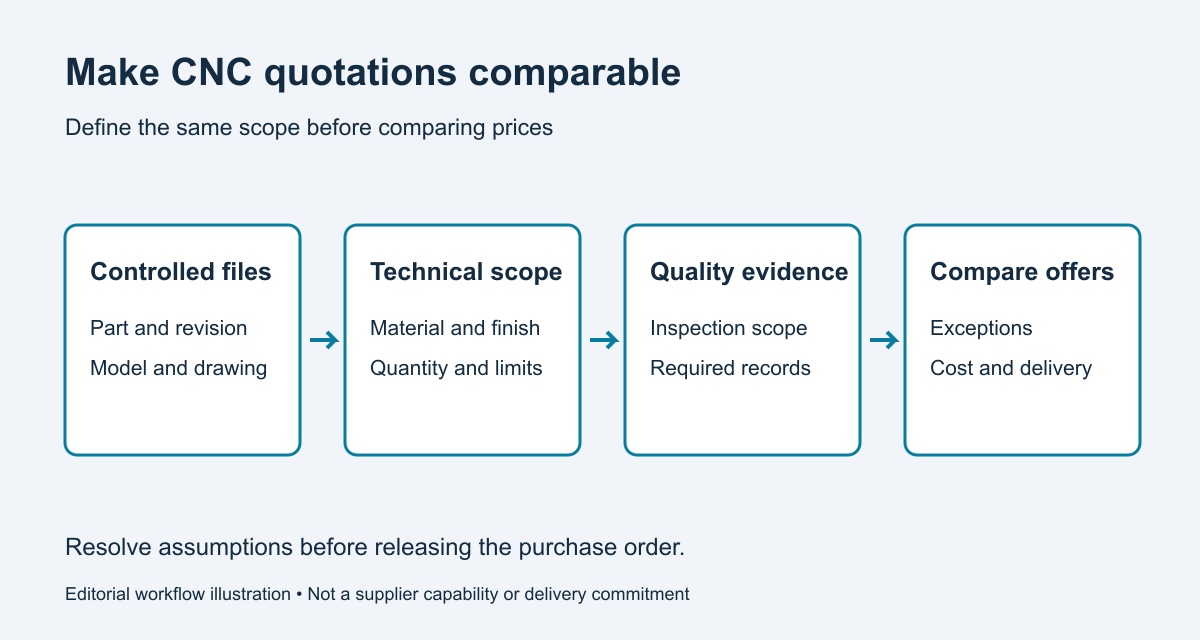
Start with a small, controlled evaluation. Keep the drawing revision, material requirements, acceptance criteria, and quotation scope consistent across suppliers. Otherwise, you may be comparing different offers while assuming the lowest unit price is the best choice.

A CNC machining supplier should show evidence like your part
For a CNC machining supplier, match the enquiry to the work involved: turned shafts, multi-face housings, thin sections, threaded features, or visible finished surfaces. Ask what aspects need review and what information is missing. A relevant discussion of access, workholding, finishing, or inspection is more useful than an unsupported statement that every part can be made.
A CNC machining supplier should only be asked for information they may share. An anonymized inspection example or authorized component photograph can be useful. Another customer’s confidential drawing should not be required to prove competence.
Check the identity and scope behind the claim
Confirm the legal company name of the CNC machining supplier, the quotation entity, manufacturing location, and contact responsible for technical questions. Where a certificate matters to your purchasing requirements, check the named organization, scope, expiry, and issuing body. A logo on a website does not establish that your intended process is within the certified scope.
Clarify which operations a CNC machining supplier will perform at the proposed facility and which will involve another provider. If heat treatment, plating, or testing is external, agree how the supplier controls requirements and retains records. An external operation should be disclosed and controlled rather than discovered after delivery.
Use the trial order to test a defined scope
| Evaluation point | Ask before ordering | Check when the trial arrives |
|---|---|---|
| Drawing control | Which revision is quoted, and which exceptions remain open? | Part and report identification match the approved revision. |
| Material | Which grade, condition, and documentation are included? | Records correspond to the supplied material and agreed traceability. |
| Critical features | Which characteristics are checked, by what method and sampling scope? | Results address those characteristics; investigate unexplained differences. |
| Appearance | Which surfaces are visible, and what defines acceptance? | Finish, handling damage, and packaging satisfy the agreed criteria. |
| Commercial scope | What tooling, finishing, documents, freight, and exclusions are included? | Delivery contents and charges match the accepted quotation. |
Read inspection records as evidence, not decoration
A report from a CNC machining supplier is useful when its results can be connected to the drawing and the supplied parts. Check the part number, revision, characteristic identification, units, measured values, acceptance limits, and relevant inspection information. Clarify whether it covers all parts, selected samples, or only specified features.
If incoming results disagree, ask the CNC machining supplier to compare the reference setup, measured characteristic, part condition, and method before deciding that either reading is automatically correct. Keep the physical parts and records identified while the discrepancy is investigated.
NIST’s work on manufacturing-data traceability supports the importance of preserving trustworthy links between requirements and records. It does not endorse any particular supplier or replace your qualification procedure.

Define what happens after the sample is approved
Record with the CNC machining supplier the approved revision and outstanding actions. Specify which substitutions or changes require permission, including material changes, altered finishing scope, or proposed changes to an agreed manufacturing or inspection route. Agree how parts and records will be identified on repeat orders.
Do not interpret a small successful trial with a CNC machining supplier as proof of stable performance at every quantity. Review repeat orders for delivery, documentation, defects, responsiveness, and corrective actions. Your purchasing team should decide which checks remain necessary as the relationship develops.
Compare each CNC machining supplier on the same basis
Use a short scorecard built around the actual project: technical understanding, evidence quality, declared exceptions, trial results, communication, and total delivered scope. Weight these factors according to the cost of failure in your assembly. Do not borrow arbitrary weights simply because they appear in a procurement template.
Related resources: CNC machining RFQ checklist and custom CNC machining services.
Reference
NIST: Recommendations on Ensuring Traceability and Trustworthiness of Manufacturing-Related Data. The qualification checklist above is practical purchasing guidance, not a claim that NIST certifies suppliers.
What a trial order can and cannot prove
A small trial is the most useful way to test a CNC machining supplier before committing a production programme. It shows whether the supplier can interpret the drawing, control the process, inspect the result and communicate when something is unclear. The trial should use the same drawing revision, material, tolerance and finish that the production order will use. A sample made from a convenient substitute tells you little about the real work.
A trial cannot prove long-term stability. A supplier can produce one good part with extra attention and still lack the process control needed for a hundred. Define what the trial is meant to demonstrate, whether it is dimensional conformity, surface finish, material documentation or communication. Add a small repeat quantity if consistency matters, and review the results rather than the single best part.
Keep the trial conditions in writing: the files released, the revision, the material, the inspection scope and any exceptions. When the production order arrives, the same baseline makes it possible to judge whether the supplier is still meeting what was approved. A trial that is not documented is only a memory, and memories change when teams change.
Reading evidence without being impressed by it
Suppliers can show photographs, certificates and inspection reports, and these are useful when they can be tied to a real part. Ask what a report measures, which drawing revision it refers to and whether it belongs to the offered facility. A generic certificate that cannot be connected to the stock or a photograph of an unrelated part should not influence the decision, however professional it looks.
An anonymized example may be all a supplier is permitted to share, and that is reasonable. The useful question is whether the evidence resembles your type of work: similar geometry, tolerance, material and finishing route. A CNC machining supplier with excellent records for simple turned parts may still be unfamiliar with thin-wall housings or multi-face fixtures. Match the evidence to the risk in your part.
Where a claim involves a standard or a capability, ask for the exact scope. A machine list says nothing about whether the relevant process is qualified, and a quality-system certificate does not establish that a particular tolerance is held. Focus on evidence that can be checked against your requirements rather than on the volume of documentation supplied.

Change control after approval
A supplier that performs well on a trial can still change something later. A new machine, a different material source, an outside process or a revised drawing can all affect the part. Agree in advance which changes require notification and approval. A CNC machining supplier who tells you about a change before shipping is easier to work with than one who explains it after a batch fails.
Record the approved revision and outstanding actions in a short agreement. State who approves substitutions, what evidence is required and how a first article will be handled after a change. This is not about distrust; it is about making the relationship repeatable. Clear rules let both sides act quickly when something inevitable changes.
Review performance at defined intervals rather than only when a problem occurs. Look at delivery, quality, communication and the accuracy of the documentation. A small decline in any of these is easier to correct early. For a critical part, a periodic review of the CNC machining supplier is part of controlling the product, not an administrative extra.

Building a scorecard that reflects the project
A generic supplier scorecard can hide the factors that matter for a specific part. Build a short one around the project: technical understanding, relevant evidence, declared scope, inspection quality, communication and change control. Score what was observed during the enquiry and the trial, not what was promised. A supplier with strong answers to the right questions is a better prospect than one with an impressive brochure.
Weight the items according to risk. If material traceability is critical, give it more weight than delivery speed on the first order. If a tight cosmetic finish drives the product, evidence of similar finished parts matters more than a long list of machines. The aim is a decision that can be explained to a colleague, not a number that pretends to remove judgment.
For the RFQ checklist and a CNC machining review, send a controlled drawing and state the evaluation criteria. Then ask YUEYI to explain the proposed process before a trial order. A clear comparison protects the buyer and gives a serious supplier the chance to show what it can do.
Questions that reveal how a supplier thinks
The answers to a few practical questions reveal more than a long capability list. Ask a CNC machining supplier how they would locate a part like yours for the first operation, where they expect the tolerance to be hardest to hold, and what they would inspect before release. A supplier who has thought about the work will describe the risks. One who has not will give a generic answer about equipment.
Ask what they need from you to do a good job. A serious partner will request the revision, material condition, critical features, inspection requirements and finish details. A supplier who accepts an incomplete enquiry without questions may simply be planning to interpret the gaps in the cheapest way. Clarifying questions at the quotation stage are a sign of engagement, not difficulty.
Finally, ask how they handle a nonconformance. A defined process for identifying, containing and reporting a problem is more valuable than a claim that problems never happen. Ask for an example of how a past issue was resolved. The answer shows whether the CNC machining supplier treats quality as a system or as a matter of inspecting the output.
Communication across time zones and languages
An overseas CNC machining supplier adds communication distance to the normal project risks. Agree early who owns technical decisions on each side and how questions will be handled. A single named contact on the buyer side and one on the supplier side prevents a decision from being made by someone without the full context. It also shortens the time between a question and an answer.
Write technical requirements in plain, specific language. Avoid idioms and ambiguous words, and confirm that drawing notes are understood the same way. Where a term has a precise meaning, name the standard or the measurement method. A phrase that seems obvious in one country can be interpreted differently in another, and the cost of a misunderstanding is usually paid on the shop floor.
Set an expectation for how quickly deviations will be reported. If a supplier discovers that the specified material is unavailable, the buyer needs to know before stock is cut, not when the parts are shipped. A CNC machining supplier who reports problems early and proposes options is easier to trust than one who tries to solve them silently. Make that expectation explicit in the enquiry.
Material and process scope in the quotation
A quotation should state the material grade and condition assumed, the operations included, the finish and the inspection scope. If a process will be sent to another provider, that should be visible. A CNC machining supplier who subcontracts heat treatment or plating is not necessarily a poor choice, but the buyer needs to know where those steps occur and who is responsible for the result.
Compare the quoted scope against the drawing feature by feature. A low price may exclude a finish, a test or a documentation item that the production order will require. Ask each supplier to quote the same scope so the comparison is meaningful. If one bid includes material certificates and another does not, the difference will appear later as a cost or a quality gap.
For a critical part, ask how material identity is preserved from receipt to shipment. A CNC machining supplier who can connect a certificate to the finished parts through a traceability system gives you evidence that cannot be produced after the fact. This matters especially when an alloy substitution or a process change is proposed during production.
Using the trial as a basis for a longer relationship
A successful trial is the beginning of a working relationship, not the end of the evaluation. Record what went well and what needed clarification, then carry those lessons into the production order. If the supplier asked good questions, make those questions part of the standard enquiry package. If a drawing note caused confusion, fix the note rather than relying on the supplier to remember the answer.
Keep the scorecard alive during the first production runs. Compare delivery, quality and communication with the trial baseline. A CNC machining supplier who maintains the trial standard at volume has demonstrated something meaningful. One who improves the sample and then drifts is telling you where the real process limit sits.
Finally, decide what would cause you to re-evaluate. A repeated quality issue, a change of ownership, a move of the production facility or a significant design change are all reasonable triggers. Defining them in advance makes the decision easier when it arrives and avoids letting a single bad batch erase a record of good work.
Starting the evaluation with a clear enquiry
The quality of a supplier’s response begins with the quality of the enquiry. Send a controlled drawing, the material requirement, the quantity, the critical features and the inspection you expect. State whether alternatives are allowed and who must approve them. A CNC machining supplier given complete inputs can quote a realistic process; one given a sketch and a price target must guess.
Say what the evaluation is for. If the first order is a trial, say so and describe what you want to learn. Some suppliers treat a trial as a chance to demonstrate capability and will invest in the documentation and inspection that matter to you. Others treat it as a small order to be processed quickly. Being clear about the purpose helps you tell the difference.