
A quotation offers a Chinese aluminum material as an equivalent to the material on an overseas drawing. The alloy name looks familiar and the price is attractive, but the certificate refers to a different standard or product form. Releasing the order on the strength of a cross-reference table can leave an important requirement unverified. This article sets out how to review an aluminum substitution without losing the original requirement.
A cross-reference is a starting point for review. It does not establish that two purchased products have the same composition limits, temper, mechanical properties, dimensions or test requirements. Ask what exactly is being proposed: the designation, the stock product, or the finished component’s required performance. Each answer leads to a different kind of evidence in an aluminum substitution review.
Read the full material callout first
Collect the drawing, purchase-order requirements and referenced specifications. Record the standard number and revision, alloy designation, temper or supply condition, product form and relevant size. Resolve conflicts between documents before requesting an alternative. An aluminum substitution cannot be judged against a callout that is itself ambiguous.
For example, ASTM B209/B209M-21a is titled for aluminum sheet and plate, while ASTM B221-21 addresses extruded bars, rods, wire, profiles and tubes. Those published scopes are different. The two designations are cited here as scope examples, not as instructions to use these editions on a new order or as evidence that any stock complies with them. A designation that fits one product form says nothing about another — a basic point in any aluminum substitution.
Separate chemistry from the delivered product
China’s national standards platform identifies GB/T 3190-2020 as the chemical-composition standard for wrought aluminum and aluminum alloys. A composition reference is useful, but it cannot alone answer every question about an actual plate, bar or extrusion. Obtain the applicable product standard and delivery requirements as well. Chemistry is only one axis of an aluminum substitution.
The Aluminum Association maintains alloy designations and composition registrations. ISO 2107:2023 addresses temper designations for wrought aluminum products. These references describe different parts of material identification. Finding a familiar alloy number does not remove the need to check the specified condition, and it does not complete an aluminum substitution review.
| Review item | Evidence needed | What an incomplete comparison misses |
|---|---|---|
| Standard and revision | Controlled references for the requested and proposed material | A similar name may sit under a different specification |
| Chemistry | Required limits and batch results | Matching only the main alloying elements is insufficient |
| Temper and product form | Delivery condition, form and size range | A plate and an extrusion are not the same purchased product |
| Mechanical requirements | Applicable limits, specimen orientation and test conditions | A result cannot be compared without its basis |
| Traceability and approval | Certificate linked to the stock and written disposition of differences | A generic datasheet does not identify the delivered batch |
Why alloy numbers do not map one to one
Cross-reference tables group alloys by broad similarity, but the underlying composition limits are set by different standards bodies for different product traditions. A designation in one system may have no exact counterpart in another. The nearest match can differ in the permitted range of alloying elements, in impurity limits, or in which elements are controlled at all. An aluminum substitution based on a table row can therefore miss a requirement the drawing actually depends on.
Temper adds a second layer. Designations that look similar may describe different amounts of cold work, heat treatment, or natural aging. A plate supplied in one temper will not necessarily meet the mechanical properties of the same alloy in another. When an aluminum substitution is proposed, verify the temper alongside the alloy and confirm that the delivery condition matches what the design assumed.
Product form is the third layer. The same alloy can be supplied as sheet, plate, extrusion, rod or casting, each with its own standard, property range and test requirements. A substitute offered in a different form is not a like-for-like change even if the alloy name is identical. Keep these three layers—chemistry, temper and form—separate in the review record.
Name the relationship accurately
Use “same alloy family” when that is all the evidence establishes. Use “candidate for substitution review” when the proposed material still needs a requirement-by-requirement comparison. If engineering approves an alternative for one component, record the scope of that approval. It is not a declaration of universal interchangeability, and an aluminum substitution approved once should not silently become a standing permission.
Likewise, a claim of compliance with two standards needs evidence against both sets of applicable requirements. Do not create that claim by adding a second standard number to a certificate or copying a distributor’s equivalence table into the purchase order. A defensible aluminum substitution rests on evidence, not on relabeling.
Precision in language protects everyone. When a supplier says “equivalent,” ask which requirements are equivalent and which are merely similar. When a buyer writes “or equivalent” on a drawing, define who decides and by what evidence. These small clarifications prevent an aluminum substitution from turning into a dispute after the material has already been cut.
Ask for a discrepancy list, not a yes-or-no assurance
Request a side-by-side record of the requirements the proposed material meets, those that differ and those not yet verified. Keep chemical composition, mechanical properties and testing separate. If a required characteristic is absent from the certificate, decide whether additional evidence or testing is needed before release. A clear discrepancy list is the working document of an aluminum substitution review.
Consider the component’s actual use when engineering evaluates a difference. Machinability, surface treatment, corrosion exposure and service loading may matter even when a quoted strength value appears acceptable. The review must establish which requirements are necessary; a purchasing agent should not silently delete them to fit available stock. An aluminum substitution that passes on paper can still fail in service if the functional requirement was not identified.

Testing: when it helps and when it misleads
Additional testing can close a defined gap in an aluminum substitution, but only if it answers the right question. A single tensile result, for example, says nothing about chemistry or corrosion behavior. A hardness reading is a quick check but is not a substitute for a specified mechanical property under the governing standard. Define the gap first, then choose a test method that addresses it.
Sample orientation and test conditions matter. Properties can vary with direction in wrought products, and a result from the wrong orientation is not comparable to the requirement. Test specimens should be taken and prepared under the method named in the standard, and the report should state the basis. A number without its method is a weak foundation for an aluminum substitution approval.
Testing also has limits. It verifies the sample, not every piece of stock that follows. If the substitution is accepted for a lot, keep the certificate and the test linked to that lot and to the finished parts. Treating one passing test as permanent proof is how an aluminum substitution quietly outgrows the evidence that supported it.
Carry the approval into receiving inspection
The approved alternative should appear consistently on the purchase order, material identification and inspection instructions. Keep it linked to the drawing revision and the relevant order or part numbers. Check that the received stock and certificate match the approved form and condition. Receiving inspection is where an aluminum substitution decision is either confirmed or lost.
For an initial order, agree the material evidence and any representative machining or finishing checks before production. A successful dimensional sample does not, by itself, demonstrate chemical or mechanical compliance. Keep those acceptance records distinct. If the material changes source later, treat it as a new aluminum substitution question rather than assuming the first approval still applies.
For a stainless steel example of the same review principle, see whether 304L can replace 304 in a machined part. Dual-grade certification and substitution approval need to be checked against the actual order. Review our material information alongside the machining RFQ checklist. To evaluate availability without losing the original requirement, send the full material callout and identify any permitted alternatives. YUEYI should not treat an unapproved equivalent as authorization to change your drawing.
Document the decision, not just the result
A substitution that is agreed verbally and never written down will be re-litigated on the next order. The approval record should state what was requested, what was proposed, which requirements differed, what evidence closed each gap, and who accepted the remaining risk. It should name the drawing revision, the product form, the temper and the specific lot or supply where relevant. That record is the difference between a controlled decision and a habit that grew without anyone deciding.
Keep the supporting documents together: the certificate, the comparison sheet, any test reports and the approval itself. When a later delivery is questioned, the team should be able to reconstruct exactly why the material was accepted. Without that file, an aluminum substitution becomes a matter of memory, and memories change when people move between projects.
State the scope of the approval in plain terms. If it applies to one order, say so. If it applies to a defined range of parts or a period, define the boundaries and the conditions that would end it. A written scope keeps an aluminum substitution from spreading to components whose requirements were never reviewed. Clear records are not bureaucracy; they are the only way to keep a decision valid over time.
Common shortcuts and why they fail
Several shortcuts recur in substitution proposals, and each has a specific weakness. A distributor equivalence table compares designations, not delivered stock, and rarely reflects the revision governing your order. A generic datasheet describes typical properties for a product family, not the guaranteed values for the batch being offered. A statement that a material “meets” a standard is incomplete without the product form and edition. Each of these can support a question, but none can close an aluminum substitution review.
Another shortcut is to rely on a previous approval. A material accepted for one part may not be suitable for a different geometry, temper or service environment. If the new component has a different wall thickness, finishing route or load case, the earlier evidence may not transfer. Reopen the review when any of those inputs changes rather than assuming the old decision covers the new one.
A third shortcut is to let price drive the conclusion. An attractive quote is a reason to explore an alternative, not a reason to lower the evidence bar. If a lower cost depends on a looser specification, an untested temper or a product form that was not requested, the saving may reappear as scrap, rework or a field failure. Cost belongs in the decision after compliance has been established, not before.
How the requirement reaches the supplier
The clearest way to avoid an unwanted substitution is to write a complete requirement in the first place. Name the standard and edition, the alloy and temper, the product form and size range, the mechanical and chemical requirements, the tests, and the documentation. Where alternatives are allowed, say who approves them and what evidence is required. A precise callout makes an aluminum substitution an explicit request rather than a surprise on the certificate.
Share the functional context where it helps. If a surface will be anodized, welded or heavily machined, say so, because these processes can make certain differences important. A supplier who understands the application can flag a genuine constraint early. A supplier who receives only an alloy number will optimize for availability and price, and any resulting aluminum substitution may miss the property that mattered.
At quotation stage, ask the supplier to state any proposed alternative clearly rather than embedding it in fine print. If the offer assumes a different standard, temper or form, surface it before the order is placed. An open discussion at this point is far cheaper than discovering the difference in receiving inspection, when material has already been purchased and machining capacity has been reserved.
What accepting an alternative commits you to
Accepting an alternative is not a one-time signature; it creates an ongoing control obligation. Once a substitute is in use, incoming material must be checked against the approved description, and the certificate must be tied to the delivered lot. If the source changes, the approval should be reviewed. An aluminum substitution that is not monitored will drift as suppliers change mills, product forms or stocking practices.
It also commits the team to keeping records for the life of the part. A design change, a new customer requirement or a field issue may require the team to show what material was actually supplied for a given batch. Traceability built at the start makes that answer straightforward. Traceability reconstructed after the fact is expensive and sometimes impossible.
Finally, acceptance should be reversible. If an aluminum substitution causes a problem, the approval record should make it easy to identify the affected lots and return to the original requirement. A decision that cannot be unwound is a risk, however reasonable it looked at the time. Define the trigger for review and the path back so the team is never locked into a choice that no longer serves the part.
For a buyer managing several suppliers, it also helps to keep a single controlled list of which substitutions are approved for which parts. One supplier’s acceptance does not authorize a different supplier to offer the same alternative, because the underlying stock and certification may differ. A shared list keeps purchasing, engineering and inspection working from the same information and stops an aluminum substitution from being re-approved informally at each reorder.
Review that list on a fixed cadence, for example when a drawing is revised or a supplier changes its source mill. A list that is never reviewed becomes as unreliable as no list at all, because the conditions behind each approval gradually stop being true. Assigning an owner and a review date turns the record into a live control rather than an archive.
Reference scope
- SAMR national standards record: GB/T 3190-2020 — chemical-composition reference.
- The Aluminum Association: Standards and Alloy Registration — alloy designation and registration context.
- ISO 2107:2023 — wrought-product temper designations.
- ASTM B209/B209M-21a and ASTM B221-21 — public title/scope references for different product forms. Consult the contractually required editions; no standard’s full requirements are reproduced here.
The review framework above is general guidance and does not declare any alloy, standard edition or cross-standard designation interchangeable. Apply the controlled drawing and the governing specification to a real aluminum substitution decision.
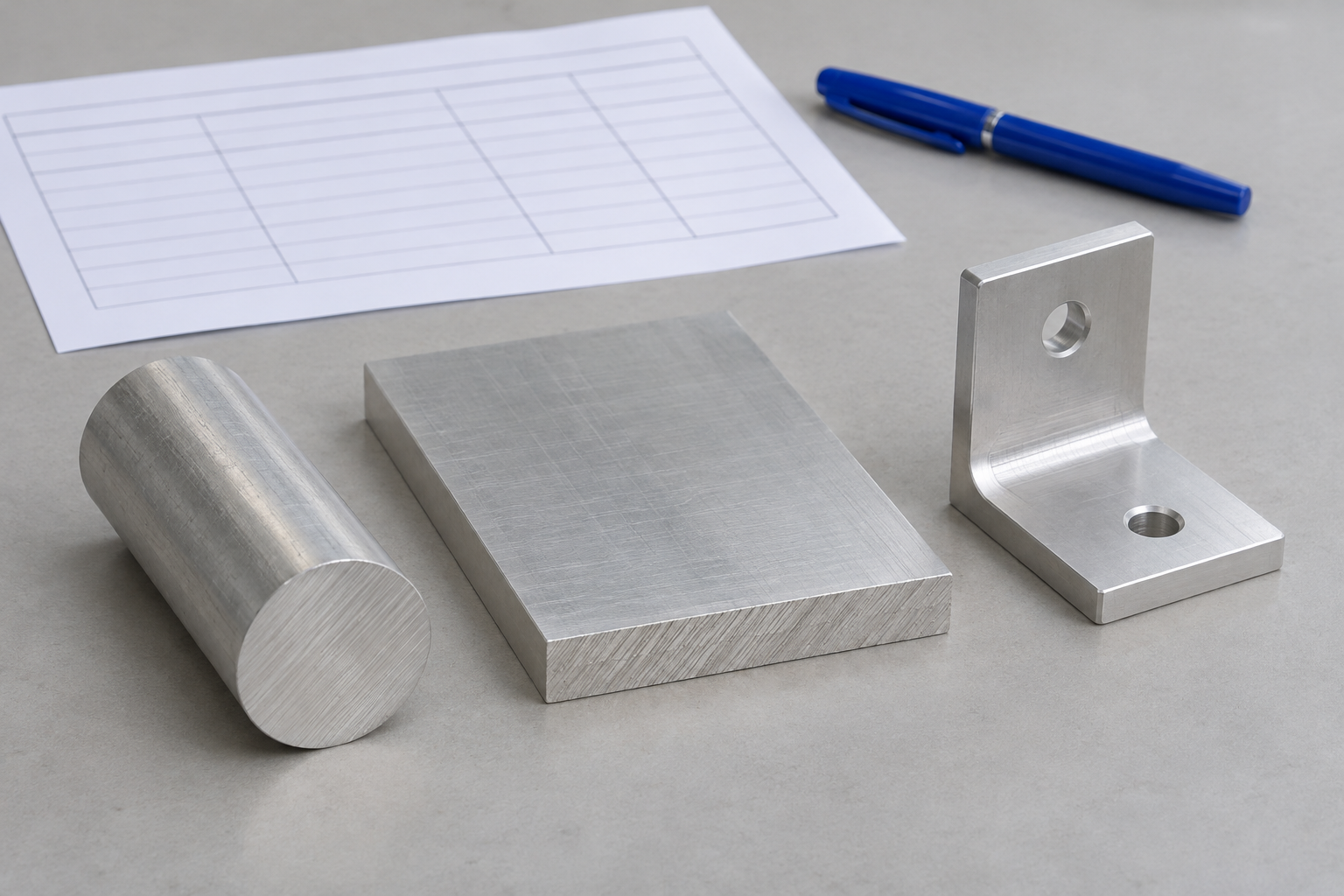
Cover: AI-generated illustrative visualization of aluminum stock and a machined bracket. Appearance does not establish alloy, temper, origin or standard compliance. The worksheet is illustrative, not a material certificate.