
A drawing specifies 304 stainless steel, but the available stock is labeled 304L. The supplier calls it an upgrade because it has lower carbon. If a buyer asks whether 304L replace 304 is acceptable and accepts that explanation without checking the specification, the finished parts may arrive with material documentation that does not satisfy the order. This article sets out how to review the proposal properly.
304L may be acceptable for a part specified as 304, but the grade name alone does not establish compliance. Review the governing material specification, product form, supply condition, required properties, and actual certificate. Where the proposal changes an order requirement, obtain approval from the responsible design or quality authority before cutting stock.
This article explains the review process. It does not declare any particular heat, standard edition, or cross-standard designation interchangeable. Whether 304L replace 304 works for a given order depends on documents and approvals, not on a general statement of similarity.
What the L changes—and what it does not prove
304L is a low-carbon member of the 304 stainless steel family. Lower carbon helps address susceptibility to sensitization and associated intergranular corrosion after certain thermal exposure, including welding. That is a reason to consider a 304L replace 304 proposal for an application, not proof that every other requirement is satisfied.
The distinction matters even if the part will only be machined. The purchase specification may control mechanical properties, delivery condition, testing, or documentation in addition to chemistry. Do not infer compliance with those requirements from a low carbon result or from a supplier’s statement that the materials are “the same.”
Low carbon also does not make 304L suitable for every corrosive environment. Material selection still needs the actual service conditions. A substitution review should not be used to avoid evaluating whether the specified alloy family is appropriate in the first place. Before agreeing that 304L replace 304 is fine, confirm the environment the part will actually see.
Why strength is the usual sticking point
The most common reason a 304L replace 304 request stalls is mechanical properties, not corrosion. Lower carbon changes the strength range that a given product standard will guarantee. A part designed around the minimum yield strength of 304 cannot automatically be accepted with 304L, because the guaranteed minimum may be lower.
This is not a reason to reject the idea outright. It is a reason to check the drawing’s load case and the applicable standard’s property table. If the design has comfortable margin, a lower guaranteed minimum may be acceptable after review. If the feature is strength-critical, the difference may be decisive. Avoid catalog “typical” values in either direction: a typical value is not a guaranteed minimum, and it is not a basis for approving a grade change.

Work hardening and delivery condition interact with this question. Cold-worked stock can reach higher strength in either grade, but the ordered condition must be stated and evidenced. When a 304L replace 304 proposal relies on a particular temper or condition, that condition becomes part of what must be verified on the certificate—not an assumption.
Read the material callout as a complete requirement
Start with the drawing, purchase order, and any referenced specification. If they only say “304,” ask what product standard, edition, and supply condition govern the order. A familiar grade label is not a complete purchasing specification, and a 304L replace 304 decision cannot be made from the label alone.
| Requirement | Evidence to compare | Common review mistake |
|---|---|---|
| Product form and specification | Standard and edition applicable to the ordered bar, plate, tube, or other form. | Using a sheet datasheet to approve bar stock without checking the bar requirements. |
| Chemistry | All required elements and limits, using the appropriate analysis and acceptance basis. | Checking carbon alone. |
| Mechanical properties and condition | Required results, delivery condition, relevant size range, test methods, and test conditions. | Treating a typical catalog value as the guaranteed property of the supplied stock. |
| Additional order requirements | Specified tests, traceability, surface condition, and documentation. | Assuming a grade match covers every purchase-order clause. |
| Change authorization | Recorded acceptance of any departure from the original requirement. | Approving a change verbally after machining has started. |
Each row is a separate gate. A 304L replace 304 proposal passes the review only when every applicable row is supported by evidence or formally waived by the authorized reviewer. Marking one row “close enough” is where undocumented substitutions begin.
Dual certification needs to describe the actual stock
The British Stainless Steel Association explains that products can be offered as dual certified to both grade designations within a particular standard. The useful evidence is a certificate identifying that compliance for the supplied product, not a stockist’s generic description of what is commonly sold. This is the cleanest route when a buyer wants 304L replace 304 without a formal deviation.
A certificate stating both grades should still be checked against the order. Confirm that it belongs to the heat or lot being supplied and covers the required product specification and condition. If only 304L is stated, do not add “304” to the paperwork simply because the chemistry looks close. Resolve the missing certification or review the proposed substitution.
Equally, a document carrying two grade names does not override a requirement it does not cover. A dual-grade statement under one product standard does not automatically establish compliance under a different national standard or a customer’s additional specification. When the order names a standard and edition, the certificate must address that standard and edition for the 304L replace 304 question to be closed.
Use a comparison sheet before releasing material
For an illustrative machined sleeve ordered in 304 bar, the review can be organized without inventing universal strength limits:
- Identify the target. Record the drawing revision, ordered grade, applicable product standard and edition, delivery condition, and additional requirements.
- Identify the proposal. Record the actual 304L stock form, dimensions, certificate, heat or lot identity, and any proposed processing.
- Compare line by line. Mark each requirement as supported, not supported, or needing clarification. Attach the evidence rather than replacing it with a general equivalence table.
- Close the gaps. Obtain corrected or additional documentation where justified, or ask the authorized reviewer to assess a departure. Extra testing should answer a defined gap and use an agreed method.
- Release and preserve identity. Record the decision and keep material identification connected to the blanks, job, and finished components through the agreed traceability system.
The example is a planning scenario, not a YUEYI production case. The applicable standard must supply the real limits and test requirements. No numerical acceptance table in this article replaces that review. A written sheet is what turns a casual 304L replace 304 request into a traceable decision.

Traceability survives the change, not just the certificate
A grade decision on paper is only useful if the physical material can still be identified later. When a 304L replace 304 substitution is accepted for a specific heat or lot, mark the stock, blanks, and in-process parts so that the approval travels with them. A certificate that cannot be tied to the finished components does not prove what went into them.
Traceability gaps most often appear after machining, when bars from several lots are mixed or remainder pieces are returned to stock. If the accepted lot is not segregated, a later job may consume material that was never covered by the decision. Agree a simple identification rule at the start of the job and keep it through to the delivery documentation.
For regulated or safety-related parts, the traceability requirement is usually explicit. For general machined components it may be a customer expectation rather than a written clause. Ask which level applies before the 304L replace 304 decision is made, so the record is built to the right standard from the beginning.
Do not let a drawing revision hide the material change
If the substitution is approved, state exactly what was accepted: a particular heat, a defined supply, or a revised material requirement. An approval for one delivery should not silently become permission for all future orders. Each time 304L replace 304 is proposed on a new order, the material callout should trigger a fresh check against the current documents.
Keep the approved material decision with the current drawing and purchase documents. Confirm whether welding, heat treatment, surface processing, or functional acceptance is affected. Material compliance and dimensional conformity remain separate checks; a passing dimensional report does not establish material identity.
For a broader example of cross-standard review, see evaluating a proposed Chinese aluminum material against a drawing requirement. The review principle carries across materials, but the alloy limits and acceptance rules do not. The same discipline applies whether the question is 304L replace 304 or any other proposed equivalent.
What to send with a stainless steel machining enquiry
Include the current model and drawing, material specification and edition, stock or delivery condition, quantity, service environment, and required documentation. State whether alternatives may be proposed and who must approve them. If you already know that 304L replace 304 may be needed, say so up front so the quotation is based on the material actually likely to be supplied.
For welded assemblies or critical service, identify the relevant additional review requirements. A supplier who knows the service environment can flag a genuine constraint rather than proposing a substitution that looks fine on paper.
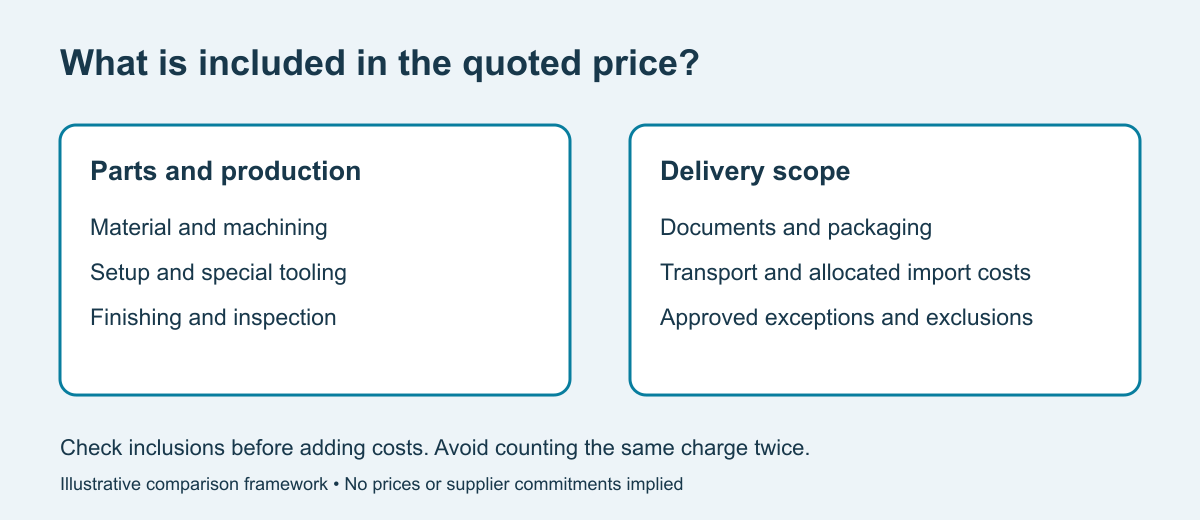
Use the machining RFQ checklist to keep quotations comparable. For a custom CNC machining review, send YUEYI the drawings and material requirements and ask for any proposed substitution to be stated clearly before approval. A clear 304L replace 304 answer depends on clear inputs.
Welding and thermal exposure change the calculation
For a machined part that will later be welded, the case for a 304L replace 304 substitution is often stronger, because low carbon specifically reduces sensitization risk in the heat-affected zone. But “stronger” does not mean automatic. The welding procedure, section thickness, heat input, and any post-weld heat treatment still belong in the review. A grade choice cannot compensate for a procedure that the governing code does not accept.
Ask what the part will experience after machining. If there is no welding and no significant thermal exposure, the corrosion argument for 304L replace 304 may be largely irrelevant, and the strength question becomes the deciding factor. If there is welding, document the procedure and confirm that both the base material and any filler are appropriate for the service. The substitution review should follow the actual process, not a generic assumption about stainless steel.
For machined components that are only lightly heated, the difference between the grades may have little practical effect, yet the documentation difference remains. Approving 304L replace 304 in that situation is a paperwork decision as much as a metallurgical one. Make sure the certificate and the order agree, and record why the change was accepted.
Machining behavior is similar but not identical
From a machining standpoint, 304L and 304 behave similarly enough that cutting parameters developed for one usually transfer to the other with minor adjustment. Both work harden, both generate heat that must be managed, and both reward sharp tools and consistent feed. A shop does not normally need a completely new process to run 304L replace 304 stock. That said, “similar” is not “identical.” Slight differences in strength and work-hardening response can change tool life or surface finish at the edge of a process window. If a feature is marginal, expect to recheck the setup rather than assuming the previous results will repeat exactly.
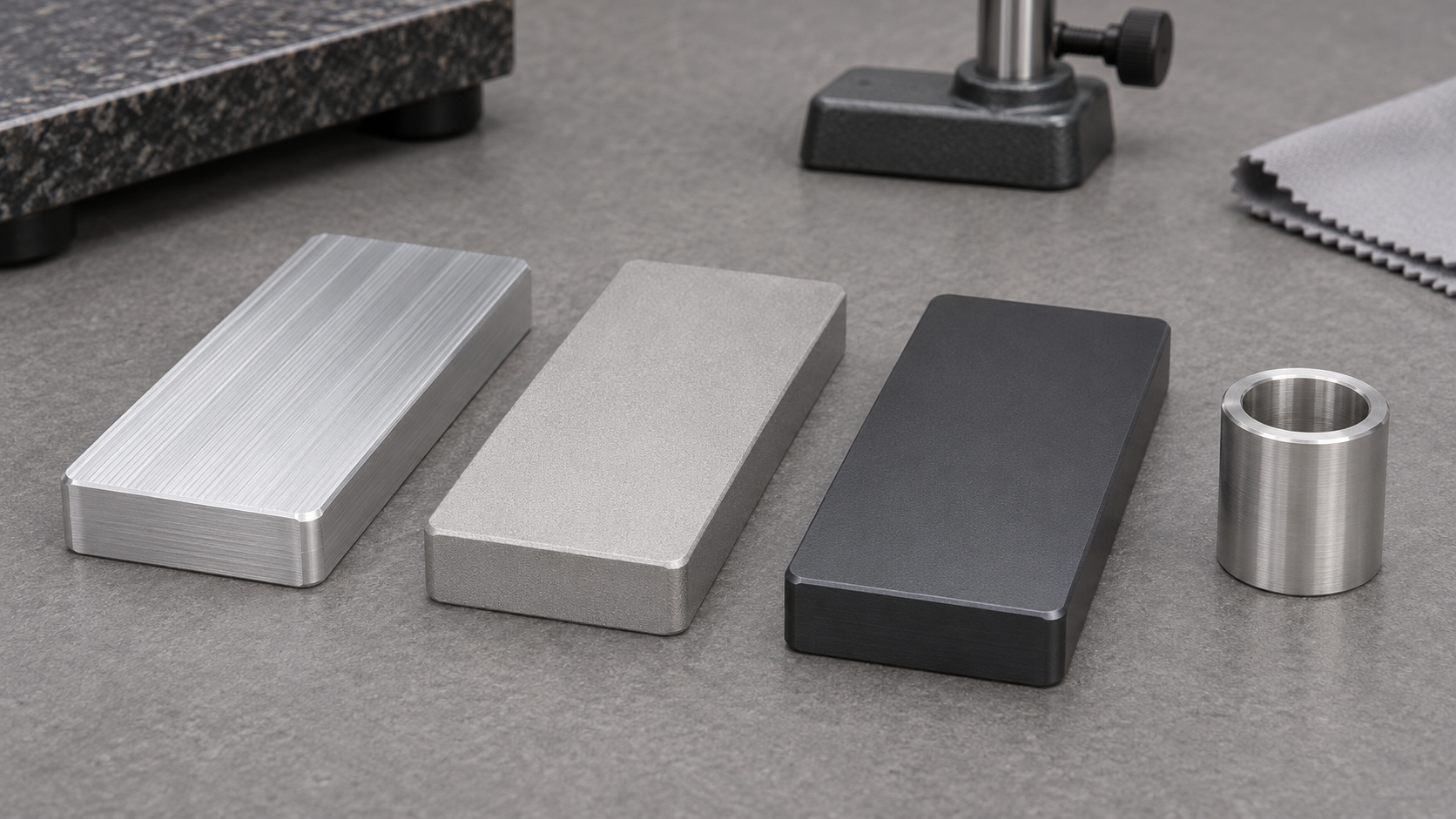
For a buyer, the practical point is that a 304L replace 304 change should not be treated as invisible to production. Even when the part prints the same, the process record should note which grade was actually cut. This matters if a later batch behaves differently: the first question will be whether the material changed, and the answer should be in the record rather than in someone’s memory.
Cost and availability are reasons, not approvals
In many markets 304L is as easy to source as 304, and sometimes easier. A supplier may propose 304L replace 304 simply because it is what is on the shelf. Availability is a legitimate practical reason to raise the question, but it is not a technical justification on its own. The proposal still has to pass the same review of specification, properties, and documentation as any other change.
Similarly, a lower price is not evidence of equivalence. If a 304L replace 304 offer comes with a cost reduction, check whether the certificate covers the order and whether any required tests have been dropped. A quote that quietly assumes a cheaper condition or a looser specification is not the same offer, even if the grade names look familiar.
How to write the approval so it stays valid
The wording of an approval determines how long it remains useful. “304L is fine” is not a decision that survives a new purchase order, a different product form, or a change of supplier. A durable approval for a 304L replace 304 request states the scope: which drawing revision, which ordered specification and edition, which product form, which grade or grades, and whether it applies to one delivery or to a defined family of orders.
It should also name who approved the change and on what basis. If the decision rests on a strength review, attach the calculation or the standard clause. If it rests on dual certification, attach the certificate. If it rests on the absence of welding, say that explicitly, because the conclusion changes if the part later goes into a welded assembly. A 304L replace 304 approval that records its reasoning can be re-evaluated when any of those inputs changes; one that does not simply gets repeated until it causes a problem.
Set an expiry or review point where practical. Material standards are revised, suppliers change their sources, and designs get updated. An approval tied to a specific drawing revision and certificate naturally expires when either changes. If a buyer wants standing permission for 304L replace 304 across many orders, define the conditions under which the permission no longer applies, such as a service-environment change or a new specification edition. That is safer than assuming a one-time answer covers every future case.
Finally, make the approval easy to find. Store it with the drawing and the purchase documents rather than in an email thread. When an auditor or a customer asks why the delivered material differs from the original callout, the answer should be a single controlled record that explains the 304L replace 304 decision, its scope, and its evidence.
Technical references and limits
- ASSDA: 304—The Place to Start — background on the 304 family and the purpose of low-carbon variants.
- BSSA: comparison of standard and low-carbon stainless types — grade differences and the scope of dual certification. Its general guidance does not replace the standard and edition governing an order.
- Outokumpu: austenitic stainless steel types — producer context for the grade family, not evidence of YUEYI stock or a specific material delivery.
The review steps above are a planning framework, not a declaration that any grade, heat, standard edition, or cross-standard designation is interchangeable. Apply the governing specification and revision to a real material decision. Appearance in an image does not establish alloy grade.
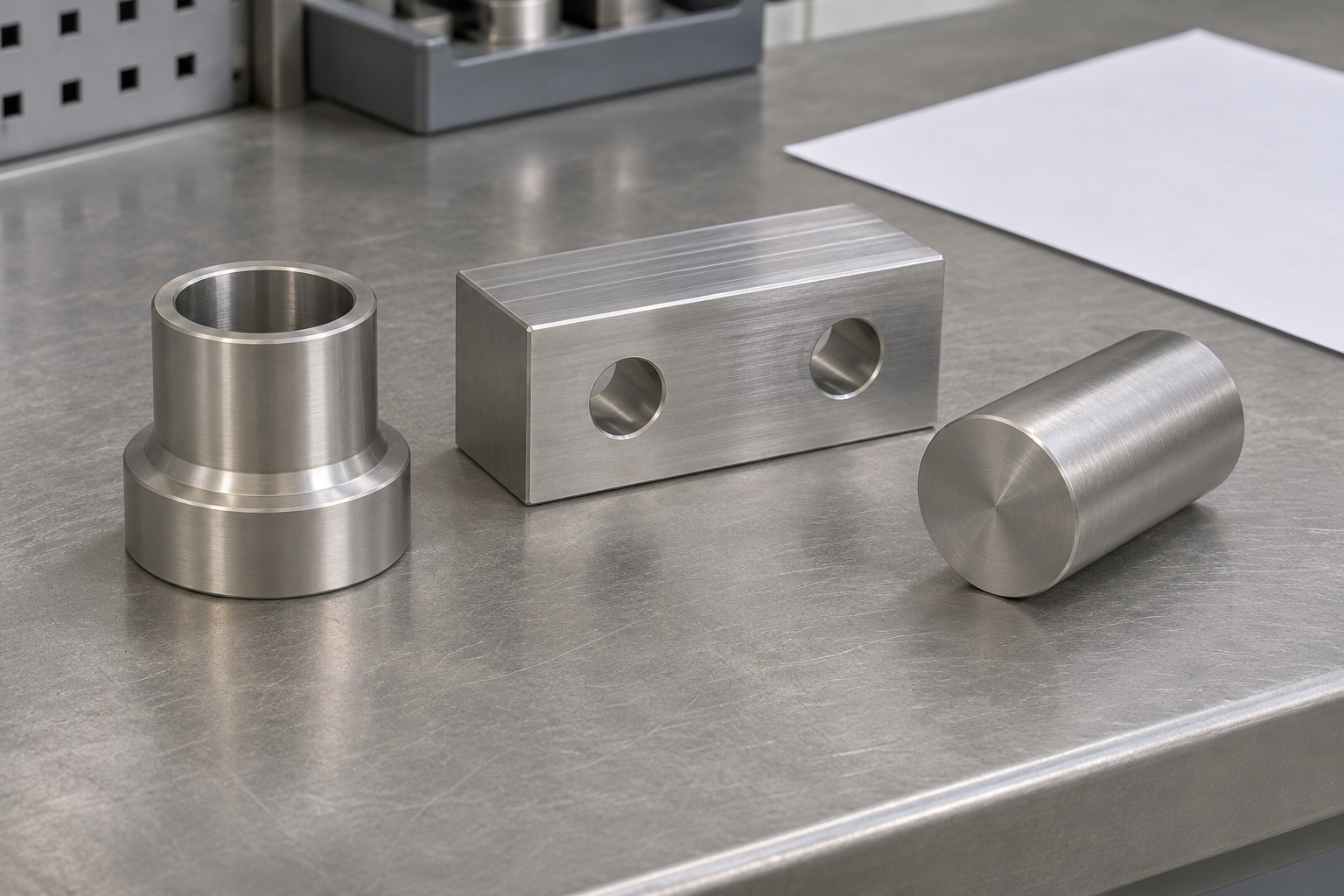
Cover: illustrative visualization of stainless steel parts and stock. It is not a material certificate or a photograph of YUEYI production.