

Many buyers face the same confusion when sourcing additive manufacturing: why do two identical-looking printed parts carry very different prices? Unlike machining or molding with more predictable rates, additive pricing is highly customized. Understanding the 3D printing quotation factors behind a price helps you evaluate budgets, improve designs, and avoid hidden charges.
The final cost is determined by a combination of technical and service requirements, not by part size alone. This guide breaks down seven 3D printing quotation factors that shape a typical factory price, and shows where a design change can reduce cost without lowering quality.
1. Technology Selection Among 3D Printing Quotation Factors
Different additive technologies have very different equipment costs, operating complexity, and efficiency. That difference sets the base price gradient among 3D printing quotation factors.
FDM is the most economical option, with low equipment and material costs, fast builds, and simple handling. It suits low-budget functional prototypes and structural verification parts in ordinary plastics. SLA and DLP resin printing cost more because they deliver very smooth surfaces and fine detail, and they need professional cleaning and post-curing. The higher precision and yield requirements raise service cost. SLS and metal printing such as SLM sit at the premium end, supporting high-strength nylon, stainless steel, and titanium for functional parts and small industrial batches.
2. Material Type and Consumption
Material is the most direct of the 3D printing quotation factors, because factory pricing is usually based on material weight and unit cost. Common PLA and ABS are the cheapest, engineering materials such as nylon, polycarbonate, and carbon-fiber composites can cost several times more, and metals are highest because of raw price and strict process control.
Support consumption also counts. A complex model may need many supports to prevent deformation during the build, which adds waste and can raise cost substantially. Designing to reduce supports is one of the simplest ways to improve a quote.

3. Part Size, Volume, and Complexity
Larger parts consume more material and occupy the machine longer, reducing factory efficiency. Deep cavities, hollow lattices, thin walls, and fine internal grooves force slower print speeds and finer parameters, then demand more manual support removal and polishing. Simple, regular solids avoid these extra costs and get the best unit price.
Complexity often matters more than envelope size. A small part with many internal features can cost more than a larger simple one, because it needs more setup, slower builds, and more finishing labor. When reviewing 3D printing quotation factors, look at feature complexity as carefully as overall dimensions.
4. Precision and Surface Finish
Tolerance and finish directly affect process difficulty and yield, which makes them important 3D printing quotation factors. A general prototype at about plus or minus 0.1 millimeter with a matte surface uses the standard process. Tight tolerances around plus or minus 0.05 millimeter, a mirror finish, no visible layer lines, or uniform gloss require tuned parameters, repeated inspection, and fine sanding, grinding, or coating.
Stricter standards also raise scrap rates and working hours. For guidance on which features truly need tight control, see our tolerances, fit, and function guide. Grading tolerances by function avoids paying for precision that adds no value.
5. Post-Processing and Custom Finishing
As-printed parts show layer lines, burrs, and support marks, so post-processing is a major variable among 3D printing quotation factors. Basic support removal and rough cleaning are often included. Paid services include fine polishing, UV curing, painting, electroplating, sandblasting, thread tapping, and assembly.
Industrial parts that need secondary machining or functional testing carry additional charges. Define which surfaces require finishing and leave the rest as printed. An independent technical drawing guide explains why a controlled drawing helps communicate these requirements clearly.

6. Quantity and Lead Time
Batch size and urgency are practical 3D printing quotation factors. Factories offer volume discounts because setup and calibration costs are shared across more parts. A single prototype carries the full setup on one unit, so its unit price is naturally higher.
Lead time also matters. Standard schedules use normal production slots. Express or urgent work needs priority scheduling, overtime, and extra shifts, which adds a surcharge. If a deadline is flexible, reserving enough time is one of the easiest savings.
7. Quality Inspection and After-Sales
General prototypes need only a visual check, while industrial parts may need dimensional inspection, tolerance verification, material certification, and a formal report. Inspection equipment and manual testing add labor and time, making quality another of the 3D printing quotation factors that buyers should clarify up front.
A reputable factory includes after-sales support such as reprints for defective parts, technical help, and design optimization. That system is part of a reasonable quote and is a practical difference between a factory-direct supplier and a low-cost workshop.
How to Optimize 3D Printing Quotation Factors
Once you understand the 3D printing quotation factors, several adjustments can lower cost without sacrificing quality:
- Choose the least expensive process that meets the requirement, rather than the most advanced one.
- Reduce redundant supports and use hollow or lattice structures to save material.
- Relax non-critical tolerances so the process is less demanding where it need not be tight.
- Combine orders into batches to share setup costs.
- Allow enough lead time to avoid urgent surcharges.
Each change should be checked against the part’s function. Saving money on a feature that controls fit or safety is a false economy.
How to Compare Quotations Fairly
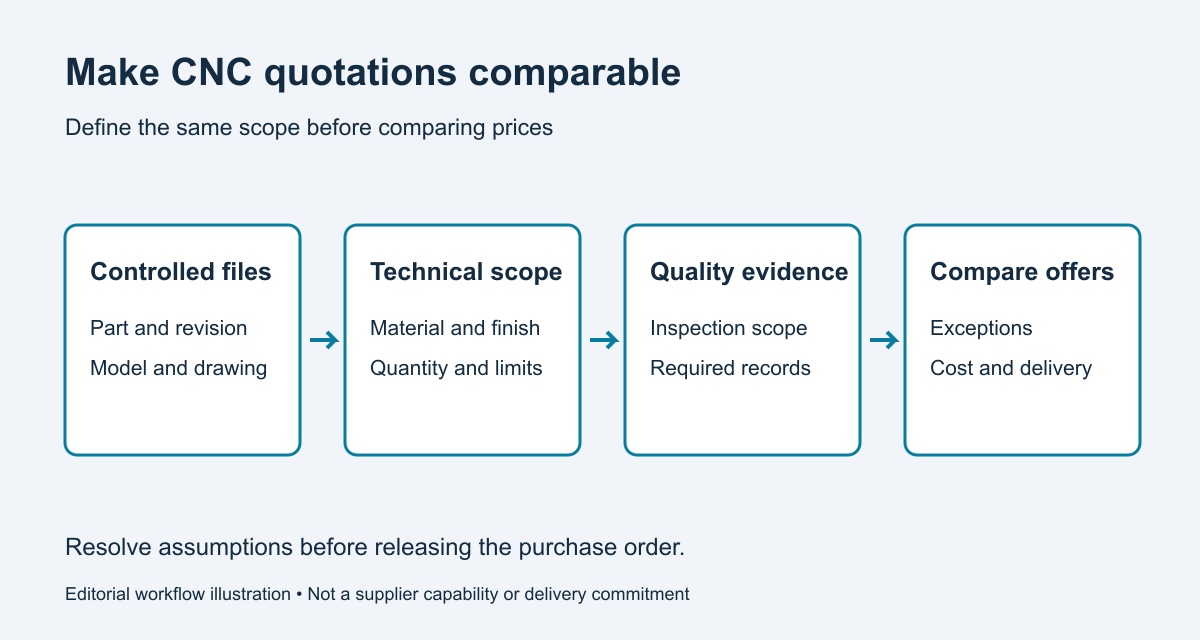
Put every offer on the same sheet. List the process, material grade, layer height, tolerances, finishing, inspection, quantity, lead time, and delivery terms. Mark exclusions clearly. If one supplier assumes a looser tolerance or skips a finishing step, that is a different offer, not a cheaper version of the same one.
Ask each bidder to state assumptions in writing and route all technical questions to every bidder so the comparison stays fair. When a revision is issued during bidding, request a revised price rather than working from an older file. Teams that also need machined parts can review our CNC machining services or request an engineering review before placing an order.
Frequently Asked Questions
Why do two quotes differ so much? Usually because the process, material, tolerance, finishing, or inspection scope differs. Compare the scope before judging the number.
Which factor has the biggest effect? Material and process choice usually dominate, followed by finishing and tolerance requirements.
Can I lower cost without losing quality? Yes. Reduce supports, relax non-critical tolerances, batch orders, and reserve adequate lead time.
Why Process Choice Dominates 3D Printing Quotation Factors
Among all 3D printing quotation factors, the choice of process has the widest effect on price. It sets the machine cost, the material family, the achievable tolerance, and the amount of manual work needed afterward. A part that could be made by FDM but is quoted in metal printing can cost many times more, not because of its shape but because of the process assigned to it.
Start with the function. If a part is a visual model, SLA usually gives the best surface for the money. If it is a tough functional component, SLS or MJF in nylon may be justified. If it must carry high load or resist heat, metal or a high-performance polymer may be necessary. Matching the process to the requirement is the first step in controlling the 3D printing quotation factors that follow.
Ask the supplier to explain the recommendation. A clear answer refers to load, temperature, tolerance, and finish. An answer that simply names one machine the shop owns is a sign that the quote may not be optimized for your part.
The Hidden Cost of Supports and Orientation
Support material is one of the 3D printing quotation factors buyers most often overlook. Supports are printed along with the part, then removed by hand. They consume material, add machine time, and leave marks that may need finishing. On a complex part, support removal can take longer than the print itself.
Orientation is the lever that controls this cost. Rotating a part so that overhangs are reduced can cut support volume sharply. Placing supports on non-critical faces avoids damage to functional surfaces. A short design review with the supplier before the build is far cheaper than paying for avoidable support work.
In powder-bed processes such as SLS, loose powder supports the part naturally, which is one reason they suit complex geometries. This advantage should be weighed against the higher material and machine cost when comparing 3D printing quotation factors across processes.
How Tolerance Grade Shapes the Price
Tolerance is among the most sensitive 3D printing quotation factors because it affects yield. A looser tolerance lets the supplier run faster and accept more parts. A tight tolerance requires slower parameters, calibration, inspection, and a higher reject rate, all of which are built into the price.
Grade tolerances by feature. Appearance surfaces and non-matching structures rarely need more than a general tolerance. Assembly holes and contact faces may need moderate control. Bearing seats or precision mating surfaces may justify fine layers and secondary finishing. Stating this on the drawing prevents a supplier from applying the tightest value everywhere.
When a tight tolerance is genuinely required, ask whether it applies to the as-printed part or after a finishing operation. Printing near-net and machining the critical feature can be cheaper than trying to hold a tight tolerance directly in the print.
Quantity, Nesting, and the Learning Curve
Quantity changes how nearly every fixed cost is shared, which is why it appears high on any list of 3D printing quotation factors. Setup, calibration, and machine preparation are one-time efforts. Spread across a hundred parts they are small; charged to a single prototype they are significant.
Nesting adds another effect. When several parts fit efficiently on one build platform, the machine runs a fuller load and the per-part cost falls. For powder-bed systems, dense packing can raise output substantially without extra machine time. Designing parts to nest well, or ordering a mixed batch of several components, can reduce cost.
Repeat orders also benefit from learning. Once a build is validated and recorded, the supplier does not repeat the trial-and-error of the first run. Keeping the drawing, parameters, and inspection record together makes the next order cheaper and more predictable.
Finishing, Assembly, and Secondary Work
Finishing is a flexible group of 3D printing quotation factors because it can be scaled to the requirement. As-printed parts are usable for many internal or non-visual applications. A customer-facing part may need sanding, priming, and painting, while a functional part may need tapping, inserts, or a mating surface finished to size.
Assembly work is charged separately. If a printed component must be joined to metal parts, fasteners, or electronics, agree who performs the assembly and how it is tested. Combining several steps with one supplier can reduce handling, but it should be itemized so you can see what you are paying for.
For projects that combine printed and machined components, our CNC machining services can support both routes under one technical review.
Building a Clear Request for Quotation
A complete request removes uncertainty from 3D printing quotation factors. Include the model and a controlled drawing, the part number and revision, the quantity, the material requirement, the tolerances that matter, the finish, the inspection scope, and the delivery date. State which document governs if the model and drawing differ.
Ask bidders to list assumptions and exceptions separately. An alternative material, a relaxed tolerance, or an excluded finishing step is a proposal to review, not an approved change. Keep all questions and answers in one log and share them with every bidder so the comparison stays fair.
Clarify commercial terms as well: currency, payment terms, quotation validity, delivery rule, and where risk transfers. A low price with vague terms can become expensive once freight and duties are added. For teams new to international sourcing, our RFQ checklist explains how to structure the request.
Final Considerations on 3D Printing Quotation Factors
A quotation is most useful when it reflects a defined scope. The seven 3D printing quotation factors discussed here, from process and material to inspection and delivery, all interact. Changing one often changes another, so the goal is a balanced specification rather than a single low number.
Define the function first, then spend precision and finishing only where they matter. Compare suppliers on delivered scope, not unit price alone. With a clear request and an honest comparison, the final price becomes predictable and the parts are far more likely to work on first assembly.
Material Choices and Their Effect on 3D Printing Quotation Factors
Material selection interacts with nearly every other item in a quotation. A polymer that is cheap per kilogram may still be expensive if it requires supports, long curing, or special handling. A premium material can be economical when it removes a secondary process or extends the life of a functional part. Understanding the 3D printing quotation factors behind material pricing helps buyers avoid both extremes.
For prototypes, standard PLA, ABS, and general resins are usually sufficient. They print quickly, cost little, and are adequate for visual and assembly checks. Engineering materials such as nylon, polycarbonate, and carbon-fiber composites cost more but offer better strength, heat resistance, and durability. These are justified when the printed part must work, not just be looked at.
Metals sit at the top of the material range. Aluminum, stainless steel, and titanium require expensive equipment, strict process control, and often significant post-processing. They belong in high-load or high-temperature applications where a polymer would fail. Choosing metal for a simple bracket is one of the fastest ways to inflate 3D printing quotation factors unnecessarily.
Certification also matters. A material with a data sheet and batch traceability may cost more than a generic alternative, but it can be essential for regulated industries. Ask whether certification is required before comparing prices, so the offer reflects the real material grade and documentation.
Evaluating a Supplier Beyond the Unit Price
A quoted price is only one signal of value. The 3D printing quotation factors that matter most over a project’s life include repeatability, communication, and the willingness to flag design risks. A supplier who questions a drawing early may save a batch from failing later, even if the initial quote is slightly higher.
Look for clear process descriptions, named material grades, and an inspection plan. Ask how the supplier handles a revision during production and how exceptions are approved. A company that can explain these steps is usually better prepared to deliver consistent parts than one that competes only on price.
After-sales support is part of value as well. Confirm what happens if a part is defective, who pays for a reprint, and how technical issues are resolved. A transparent policy reduces risk and is often reflected in a fair quotation rather than the lowest one.
In the end, a useful quotation is one you can audit. When each of the 3D printing quotation factors is stated clearly, you can see where the money goes, which requirements drive the price, and what could change without harming the part. That clarity is worth more than a headline number that hides its assumptions.