

Small batch CNC sampling has become a standard step in overseas procurement. Instead of committing to a full production order, buyers now ask for a short run of machined parts to validate the drawing, material, finish, and supplier capability before scaling up. This guide explains why the shift happened and how to run a sampling project that produces useful evidence rather than a cosmetic sample.
For purchasing teams, small batch CNC sampling reduces the risk hidden in a new supplier relationship. A sample that assembles correctly, meets its tolerances, and arrives with clear inspection records tells you far more than a catalogue or a price sheet. The sections below cover specification, cost, timing, supplier selection, and the checks that separate a meaningful trial from a formality.

What small batch CNC sampling Actually Includes
Small batch CNC sampling is a short, production-intent run, typically from a handful of parts to a few dozen, made with the same processes, tooling approach, and inspection plan intended for volume work. It is not simply a visual prototype. The goal is to prove that a supplier can repeat a result, not just produce one good part on a favourable setup.
A useful trial defines the drawing revision, material grade, surface treatment, critical tolerances, and acceptance evidence up front. When small batch CNC sampling is treated as an informal favour, the supplier may use a different fixture, a softer setup, or hand finishing that will not exist in production. The sample then looks correct but predicts nothing about the batch that follows.
Ask which operations will be identical in production and which will change. If a part will eventually be made on a multi-axis cell with dedicated fixtures, a sample machined manually on a universal mill cannot validate cycle time or consistency. Agreeing this boundary is the first practical decision in small batch CNC sampling.
| Element | Prototype model | Small batch CNC sampling | Volume production |
|---|---|---|---|
| Purpose | Shape and fit only | Validate process and evidence | Repeat a stable process |
| Quantity | One to three parts | Five to fifty parts | Hundreds and above |
| Inspection | Visual or basic check | Defined method and report | Statistical process control |
| Tooling | Temporary or none | Production-intent | Dedicated fixtures |
Why Overseas Procurement Habits Changed
Three forces pushed small batch CNC sampling into the standard workflow. Longer and less predictable logistics made a failed bulk shipment expensive, quality requirements in regulated industries tightened, and digital quoting made it easy to compare several suppliers before placing an order. A short trial run answers questions that no quotation can address.
A failed production batch carries more than unit cost. It carries freight, duty, inspection labour, line downtime, and the delay of a replacement order. Against that exposure, the price of small batch CNC sampling is small. Buyers increasingly treat the trial as insurance rather than an optional extra added at the end of negotiation.
Communication also improved. Drawings, models, and inspection reports now move instantly, so a supplier can be evaluated on documented evidence rather than reputation alone. Small batch CNC sampling gives both sides a concrete object to discuss, which shortens the qualification cycle for new components and removes much of the guesswork from a first order.
The change is not limited to large accounts. Small and mid-sized buyers use small batch CNC sampling to test a new material, a tighter tolerance, or a different finish before retooling. Even when the first article passes, the trial reveals how the supplier handles revision control, packaging, and documentation under a real order rather than a sales enquiry.
Specifying a small batch CNC sampling Run Correctly
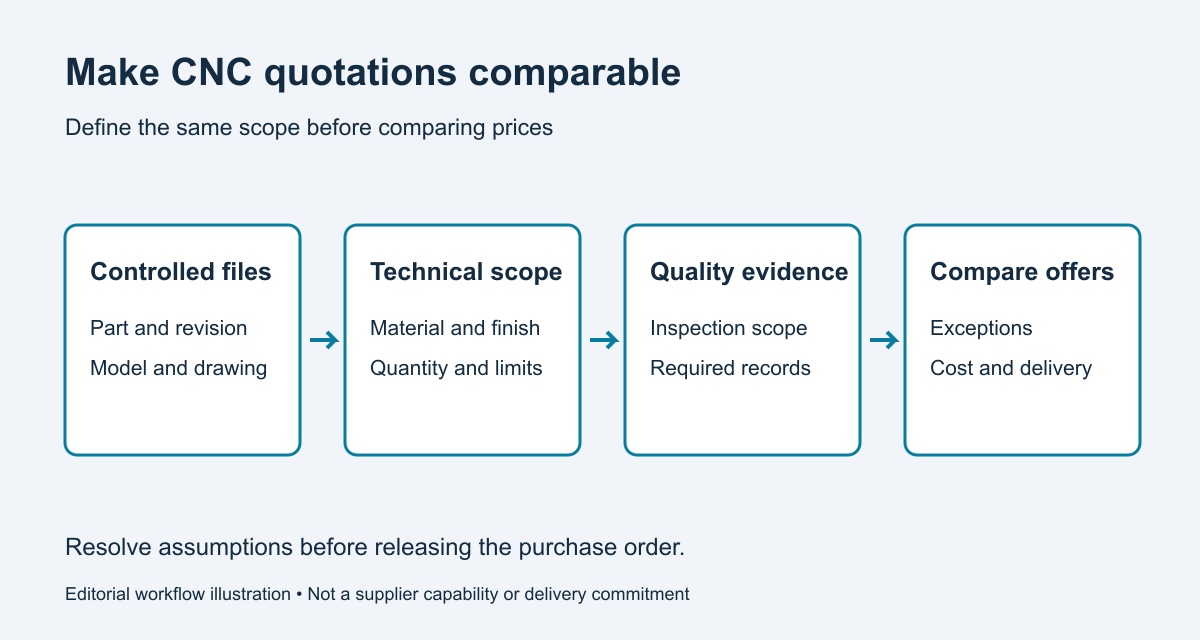
Start with a complete package: the current 3D model and drawing at the same revision, the material and any allowable substitutes, the finish, the critical characteristics, and the inspection evidence required. Mark the features that control fit and function. Ambiguity at this stage is the most common reason small batch CNC sampling produces inconclusive results that neither side can interpret with confidence.
State the governing drawing standard and edition, the units, and how conflicts between the model and drawing will be resolved. Define whether each tolerance applies before or after surface treatment. Include any edge, cleanliness, or burr requirements separately, because a size check does not cover them. For a structured template, see our CNC machining RFQ checklist, which turns these points into a repeatable form.
Ask for a documented inspection plan covering measurement method, datum alignment, instruments, and report scope. A list of coordinates is not the same as an assessment of a geometric control, and instrument resolution alone does not establish uncertainty. When small batch CNC sampling includes this detail, the resulting report becomes a baseline for comparing later batches rather than a one-off certificate.

Finally, agree the acceptance rule before machining starts. Decide which characteristics are pass or fail, which are recorded for information only, and how a borderline result will be handled. Resolving this after parts arrive turns a technical discussion into a commercial dispute, and it wastes the evidence that small batch CNC sampling was supposed to generate.
Cost Structure of small batch CNC sampling
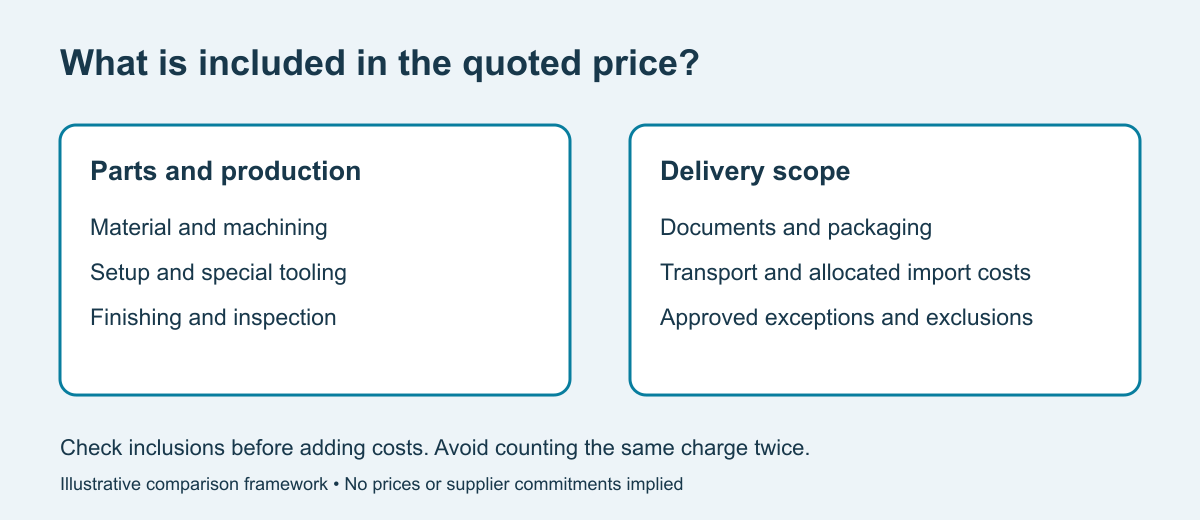
Small batch CNC sampling costs more per part than volume production because setup, programming, and first-article inspection are spread over a small quantity. That premium is expected and reasonable. What matters is whether the quote separates one-time charges from unit costs, so you can see what a repeat order would actually cost at your forecast volume.
A transparent quotation lists programming, fixtures or soft tooling, material, machine time, finishing, inspection, and packaging as separate lines. If small batch CNC sampling is priced as a single opaque number, you cannot tell whether the production price will fall as intended. Ask for the expected unit price at volume at the same time as the trial quote, not after approval.
| Cost element | Behaviour in a sample | Behaviour in production |
|---|---|---|
| Programming and setup | Fixed, shared by few parts | Amortised over the batch |
| Material | Small quantity, higher unit price | Bulk pricing |
| Inspection | First-article, detailed | Sampling plan or in-process control |
| Finishing | Often manual | Standardised line |
Tooling strategy deserves special attention. Soft fixtures keep small batch CNC sampling inexpensive but may not survive a long run or hold the same repeatability. Dedicated fixtures cost more up front but produce the consistency that volume work needs. Discuss when that transition should happen, who owns the tooling, and whether the trial price includes any of it.
Freight on a small parcel can be a surprising share of the total. Consolidating several sample parts into one shipment, or agreeing a courier account in advance, keeps the trial economical without weakening the technical scope. A cheap shipment that arrives with damaged sealing faces is not a saving.
From Sample Approval to Production
Approving a sample should trigger a controlled handover, not an informal message. Record the approved drawing revision, material lot, finishing specification, and inspection results. Any change after approval, even a small radius or a different coating, technically creates a new configuration that small batch CNC sampling has not validated and should be rechecked before a bulk order is released.
Use the trial to confirm the process route. If the supplier plans to change fixturing, switch to a different machine, or outsource a finishing step in production, ask for a bridging sample. Small batch CNC sampling is most valuable when it exposes these transitions early rather than after the first production batch has already been shipped.
Set a simple gate: design review, sample run, inspection report, assembly test, then approval. Buyers who skip the assembly test often discover that a dimensionally compliant part still interferes with a mating component. A functional check closes the loop that a coordinate report cannot, and it validates the drawing as well as the machining.
Keep one approved reference part at both ends. A physical master makes later disputes about appearance, texture, or edge condition much easier to resolve, especially when the production run happens months after small batch CNC sampling and the people involved have moved on to other projects.
Choosing a Supplier for small batch CNC sampling
Evaluate a supplier on evidence, not on claims. Ask what inspection equipment is in-house, whether measurement conditions are controlled, and who signs the report. A shop that can explain how it would measure a positional tolerance is usually better prepared than one that only quotes a machine positioning figure from a brochure.
Responsiveness during small batch CNC sampling is a useful signal. Clarifying questions about datums, finishes, or material certificates indicate that an engineering review is actually happening. A quote returned in minutes with no questions may mean the drawing was never examined closely, which is exactly the risk a trial run is meant to uncover.
Check revision control and documentation habits. Request that the sample report carry the drawing revision, part number, and date. Those details matter when a component is reordered a year later and no one remembers which version was approved, which coating was used, or which inspection method produced the recorded values.
Balance capability against communication. Our small batch CNC machining guide and rapid prototyping CNC milling guide describe how process choices differ between a trial and a run, and our CNC machining services page outlines the equipment and inspection resources available for both stages.
Common Mistakes in small batch CNC sampling
The first mistake is sending an incomplete drawing and hoping the supplier infers the rest. Missing datums, undefined surface finishes, and unspecified edge conditions produce parts that are easy to dispute. Small batch CNC sampling amplifies this problem because a small quantity offers no statistical cushion and every part is examined closely.
The second is approving on appearance alone. A polished sample can hide a tolerance that will drift over a long run. Ask for the measured values, not just a pass mark, and compare them with the limits rather than with the nominal dimension. A result near a boundary deserves a conversation before production.
The third is changing the design immediately after approval. Each revision should be treated as a new configuration until the affected characteristics are rechecked. A disciplined change note protects both sides and keeps small batch CNC sampling meaningful as a qualification record instead of a snapshot of a part that no longer exists.
A fourth, quieter mistake is ignoring packaging. Precision surfaces damaged in transit are a frequent source of false failures. Specify protective packing for the trial shipment so the inspection results reflect the machining rather than the courier, and photograph the parts before they leave the shop.
Frequently Asked Questions
How many parts should small batch CNC sampling include? Enough to show repeatability, often five to fifty depending on complexity and risk. One part proves very little about the stability of a process.
Is small batch CNC sampling the same as a prototype? No. A prototype checks form and fit; small batch CNC sampling validates the production-intent process, its tooling, and the inspection evidence that will accompany volume orders.
Why is small batch CNC sampling more expensive per part? Setup, programming, and first-article inspection are spread across a small quantity rather than amortised over a large batch.
Should the sample use the same finish as production? Yes. Finishing can change dimensions and appearance, so a different finish invalidates the comparison and hides potential problems.
What records should accompany small batch CNC sampling? The approved drawing revision, measured values, inspection method, material certificate, and any nonconformance notes or concessions agreed in writing.
Can small batch CNC sampling replace a supplier audit? It complements one. It shows how a specific part is made, while an audit assesses the wider quality system and its management controls.
Material and Finish Considerations
Material choice deserves the same discipline as dimensional planning. Ask for the exact grade, condition, and any permitted substitutes in writing, because a nominally equivalent alloy can machine, deform, or finish differently. Request a mill certificate with the heat or lot number, and keep it with the inspection record so a later batch can be traced back to the same source.
Heat treatment and surface finishing change dimensions. A part that measures correctly before anodising or plating may fall outside its limits afterwards, and masking decisions affect threaded or sealing features. Define the stage at which each critical characteristic applies, and note any restrictions on edge breaks or burrs at intersecting bores before the order is released.
Appearance is harder to specify than size. Colour, gloss, and texture vary between batches even when the process is stable, so agree a physical reference or a defined standard rather than relying on a photograph. Where aesthetics matter, approve a master panel alongside the dimensional report and store both under the same revision.
Logistics, Packaging and Documentation
Precision surfaces are easily damaged after machining. Specify individual protection for sealing faces, threaded features, and sharp edges, and ask how parts will be separated in the carton. A trial shipment that arrives scratched produces false failures and delays the qualification decision, which costs far more than the packing material.
Label every parcel with the part number, drawing revision, quantity, and date. Include the inspection report, the material certificate, and any concession notes in the same shipment and as a PDF in advance. When the documents and the physical parts carry different revisions, the receiving team cannot tell which record is authoritative.
Agree the courier, incoterm, and who handles customs paperwork before dispatch. Small parcels are often delayed by incomplete declarations rather than by distance. A short note listing the harmonised code, declared value, and a plain-language description of the goods prevents most of those holds.
Building a Repeatable Qualification Record
Treat the exercise as the first entry in a component file, not a one-off event. Store the approved drawing, the model at the same revision, the measured values, the inspection method, the material certificate, and the photographs together. A year later, that bundle answers almost every question a reorder raises.
Record the process assumptions as well: the machine type, fixture concept, finishing route, and any operations that were outsourced. If a later order changes one of them, the file makes the difference visible and triggers a review instead of a surprise at goods-in.
Note which characteristics sat close to a limit. A dimension that passed at ninety-five percent of its tolerance band deserves attention when the process moves to a different machine or a larger batch. Trending those values over successive orders turns a set of certificates into actual evidence of stability.
When a Trial Run Is Not Enough
Some components need more than a short qualification order. Safety-critical parts, pressurised housings, and features subject to fatigue may require capability studies, first-article inspection to a formal standard, or third-party testing. Discuss those requirements at the enquiry stage so the quotation includes the work rather than discovering it after approval.
Regulated industries may also expect traceability, controlled document retention, and change notification. Ask what a supplier can provide before assuming a standard inspection report will satisfy an auditor. The right question is not whether a part can be made, but whether the whole evidence chain can be reproduced.
Technical Resources
For background on preparing a clear drawing before small batch CNC sampling, see independent guidance on preparing a technical drawing for CNC machining and the ASME Y14.5 dimensioning and tolerancing standard. Clear requirements reduce interpretation disputes more effectively than a long email thread, and they give the inspection team a stable reference for every batch that follows.