
Introduction
Powder Metallurgy (PM) is a mature, near-net-shape metal manufacturing technology that has become indispensable in automotive, new energy, power tool, aerospace, and electronic precision component industries. Unlike traditional CNC subtractive machining, which cuts excess material from solid metal blanks, PM forms functional metal parts directly from metal powder, offering ultra-high material utilization, stable mass-production consistency, and low overall manufacturing costs.
Many engineers and purchasers are familiar with finished PM parts but lack a clear understanding of the complete production workflow. This blog systematically breaks down the entire powder metallurgy process chain, covering powder preparation, mixing, compaction, sintering, and secondary finishing, and explains the core principles and value of each step.
1. Metal Powder Production & Quality Inspection (Raw Material Foundation)
The entire powder metallurgy process starts with qualified metal powder. Powder particle size, fluidity, purity, and uniformity directly determine the dimensional accuracy, density, and mechanical properties of the final product. Different production methods create powders for diverse application scenarios.
Mainstream Powder Manufacturing Methods:
- Water Atomization: The most common process for iron-based and copper-based powders. Molten metal is impacted by high-pressure water flow to form fine particles, with low cost and high bulk density, ideal for general structural parts, bearing bushes, and transmission gears.
- Gas Atomization: Uses inert gas to atomize molten metal, producing spherical powders with excellent fluidity. It is widely used for high-end materials such as stainless steel, aluminum alloy, and titanium alloy, matching MIM (Metal Injection Molding) and high-precision component production.
- Chemical Reduction & Electrolysis: Mainly used for special metal powders with high purity requirements, suitable for medical devices and high-precision electronic components.
After production, all powders undergo strict screening, impurity removal, and performance testing to ensure stable batch consistency before entering the production line.
2. Powder Mixing & Blending (Formula Customization)
Single metal powder rarely meets actual performance requirements. The second core step of PM processing is precision batching and mixing. Manufacturers proportionally mix base metal powder with alloying elements, lubricants, and bonding agents according to product performance needs (wear resistance, hardness, corrosion resistance, self-lubrication).
Lubricants are the key additives in this process. They effectively reduce friction between metal powder particles and mold walls during subsequent compaction, avoiding mold wear, while improving powder fluidity and compaction uniformity. After uniform mixing, the composite powder forms a stable feedstock for formal pressing production.
3. Die Compaction & Forming (Shaping Process)
Compaction is the shaping core of powder metallurgy. The qualified mixed powder is automatically filled into precision custom molds, and pressed into fixed geometric blanks (called green parts) by high-pressure hydraulic or mechanical presses within 3–8 seconds per cycle.
Green parts have complete product contours and precise dimensions but low density and poor mechanical strength, making them fragile and only suitable for turnover, not actual use. This near-net-shape forming process requires no secondary cutting, with a material utilization rate of up to 95%—far higher than traditional machining. It is especially suitable for mass production of complex symmetrical parts such as gears, shaft sleeves, and structural brackets.
4. High-Temperature Sintering (Core Strengthening Process)
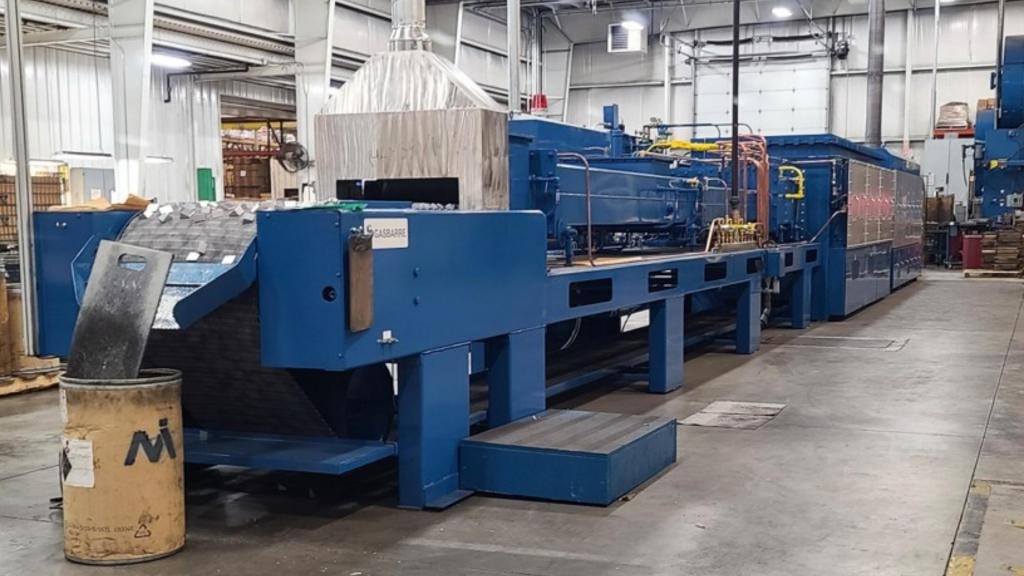
Sintering is the most critical process that determines the final performance of PM parts, and it is also the fundamental difference between pressed green parts and finished metal parts. The green parts are stably sent to a closed continuous sintering furnace, heated at a constant temperature of 70%–90% of the metal melting point under protective atmosphere (nitrogen, hydrogen mixed gas) to avoid oxidation and decarbonization.
The entire sintering process is divided into three precise stages:
- Delubrication & Burn-off Stage (400–600°C): Remove internal lubricants and residual air to clean the particle contact surface.
- High-Temperature Bonding Stage: Metal particles produce solid-phase diffusion, tightly bond with each other, and eliminate internal gaps, rapidly improving part density and structural strength.
- Constant Temperature Cooling Stage: Controlled slow cooling to stabilize the internal metal structure, avoid deformation and cracking, and lock dimensional accuracy.
After sintering, the fragile green parts are transformed into high-strength, wear-resistant, structurally stable functional metal components with complete mechanical properties.
5. Secondary Post-Treatment & Finishing (Performance Optimization)
Most sintered parts can be used directly, but for products with high precision, high hardness, and special environmental resistance requirements, targeted secondary treatments are carried out to optimize performance:
- Sizing & Coining: Fine correction of tiny dimensional deviations to improve assembly tolerance accuracy;
- Heat Treatment: Carburizing and quenching to enhance surface hardness and wear resistance for transmission gears;
- Oil Impregnation: Utilize the inherent microporous structure of PM parts to store lubricating oil, realizing self-lubricating and maintenance-free effects for bearings;
- Surface Treatment: Polishing, electroplating, and blackening to improve corrosion resistance and surface finish.
6. Core Advantages of the Complete PM Process
By sorting out the full process chain, the unique advantages of powder metallurgy in modern manufacturing are clear:
- Extremely High Material Utilization: No chip waste, saving 30%–40% of raw material costs compared with machining;
- High Efficiency Mass Production: Ultra-fast pressing cycle + continuous sintering, suitable for millions of batch production;
- Stable Batch Consistency: Mold forming avoids manual and equipment errors in machining, with low product defect rate;
- Adjustable Material Properties: Flexible formula customization to achieve self-lubrication, wear resistance, and high toughness;
- Low Comprehensive Cost: Simplified process flow, fewer secondary operations, and significant cost advantages in high-volume production.
7. Main Application Scenarios
Relying on mature and stable process technology, PM parts are widely used in new energy vehicle parts, power tool transmission components, 3C electronic micro precision parts, industrial bearings, aerospace lightweight parts, and medical equipment accessories, becoming the preferred process for high-volume precision metal parts.