
Introduction
Custom 3D printing is the fastest way to turn CAD designs into physical prototypes for product verification, assembly testing and client presentation. However, many designers and procurement teams are frustrated by high recurring costs for iterative prototype batches.
Expenses pile up from excessive material usage, slow print cycles, unnecessary premium materials and complicated post-finishing work. The good news is most cost waste happens at the design stage—small adjustments to your model, material selection and ordering habits can slash prototype expenses by 30% to 70%. Below are all practical, industry-verified tactics to save money on every custom 3D printed prototype.
1. Optimize Part Geometry to Cut Material & Print Time
Material consumption and machine runtime make up the largest share of your 3D printing bill. Simple structural edits to your model deliver immediate savings.
1.1 Hollow Solid Parts & Use Lightweight Lattice Infill
Fully solid prototypes waste massive amounts of filament or resin. Replace solid interiors with thin outer shells and low-density lattice infill. This cuts material weight drastically while keeping sufficient rigidity for testing. Most industrial printers support customizable infill density; choose 10%–30% infill for non-load-bearing prototypes instead of 100%.
1.2 Eliminate Overhangs to Remove Support Waste
Supports consume extra material and add manual labor for removal. Follow the standard 45-degree design rule: redesign steep downward-facing surfaces with chamfers, fillets or self-supporting angles. Fewer supports equal less material waste and shorter post-processing hours.
1.3 Merge Multiple Small Prototypes Into One Build Plate
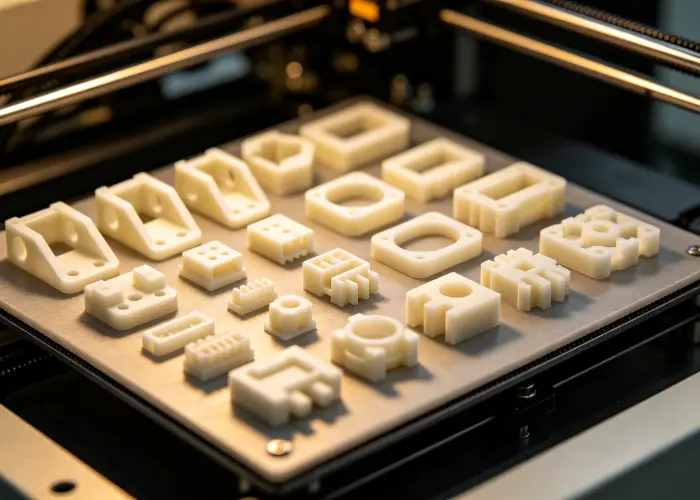
If you need several small test parts, combine all models into a single STL file to print in one batch. The fixed machine startup fee is shared across all components, lowering the individual cost of each prototype. Avoid separate orders for tiny single pieces whenever possible.
1.4 Shrink Unnecessary Tolerance Requirements
Ultra-tight dimensional tolerances force slower layer heights and more precise calibration, raising printing time. Relax tolerance standards for non-critical surfaces that do not fit with other components. Reserve high-precision fine layers only for mating holes, shafts and assembly interfaces.
2. Choose Cost-Effective Materials Matching Your Prototype Purpose
Many clients overspend by selecting premium-grade materials when basic plastics fully meet their testing needs. Match your material to the prototype’s function.
- Visual-only appearance samples: Standard PLA or general-purpose SLA resin are the cheapest options, ideal for form validation and display models.
- Functional test prototypes: Affordable PETG or regular nylon replaces expensive carbon fiber-filled plastics for most mechanical testing.
- Skip metal 3D printing at early design stages: Use high-strength plastic prototypes first for iteration; switch to SLM metal only for final functional verification.
- Avoid specialty medical, high-temperature or flame-retardant materials unless your project has strict regulatory requirements.
3. Adjust Printing Parameters to Lower Hourly Machine Fees
Printer operating time directly impacts pricing, and minor parameter tweaks speed up production without hurting basic prototype quality.
- Raise layer height for non-cosmetic parts: 0.15mm–0.2mm layers print much faster than ultra-fine 0.02mm–0.05mm layers. Only use thin layers for visible exterior surfaces.
- Reduce print resolution for internal hidden structures.
- Lower print speed restrictions where surface smoothness is not a priority, with supplier approval.
4. Minimize Expensive Post-Processing Work
Sanding, polishing, coating, dyeing and secondary CNC machining add significant labor costs. Streamline finishing workflows to cut extra charges:
- Keep raw sanded finish for internal testing prototypes; reserve high-gloss polishing or painting only for marketing display samples.
- Limit anodizing, electroplating and biocompatible sterilization treatments to final small-batch products, not iterative test prototypes.
- Simplify threaded holes and deep grooves: Add basic tapping after printing instead of printing tiny precise threads that require long print times.
5. Optimize Your Order & Iteration Workflow
Poor ordering habits create repeated hidden costs throughout your product development cycle.
5.1 Complete Design Validation Before Mass Prototyping
Send fully reviewed, error-free STL files to manufacturers. Models with broken meshes, overlapping geometry or missing details require engineering rework fees and delayed reprints. Run self-check repair tools on your CAD files first.
5.2 Batch Multiple Design Revisions in One Order
Instead of placing separate small orders after every minor design change, accumulate several revised versions and print them together. This reduces repeated setup, quotation and shipping overhead.
5.3 Order Reasonable Quantities for Iteration
Order 3–5 identical prototypes in one run rather than reprinting one piece multiple times if breakage occurs during testing. Bulk small batches reduce per-unit pricing compared to one-off single samples.
5.4 Combine Prototypes With Other Manufacturing Orders
If you also need CNC machined or sheet metal parts, bundle all manufacturing requests into one order with the same supplier. Many factories offer combined order discounts and cut separate international shipping fees.
6. Partner With a Full-Service Manufacturer for Better Pricing
Choosing a one-stop additive manufacturing supplier brings long-term cost advantages over small local print shops:
- In-house equipment eliminates outsourcing markup fees for printing and post-processing.
- Large raw material inventory allows suppliers to offer stable, bulk material pricing.
- Free design review service: Professional engineers optimize your model geometry at no extra cost to reduce print material and time.
- Discounted pricing for repeated prototype and small-batch orders for long-term cooperative clients.
At Yueyi, we own a complete 3D printing production line including FDM, SLA and SLM metal printers, plus dedicated post-processing workshops. Our engineering team provides free CAD optimization suggestions to lower your prototype costs before production. We support fast one-day prototype delivery, transparent itemized quotations without hidden fees, and combined manufacturing solutions with CNC, sheet metal and die casting for global industrial clients.