
Introduction
Powder metallurgy (PM) is a near-net-shape manufacturing technology that transforms metallic powders into high-precision components through compaction and sintering. Unlike traditional machining or casting, PM builds parts particle by particle — offering unmatched material efficiency, design flexibility, and scalability for high-volume production.
From automotive gears to medical implants, aerospace components to electronic connectors, powder metallurgy has become the go-to process for parts that demand consistent quality, complex geometries, and controlled material properties.
Step 1: Powder Production
The quality of any PM part begins with the powder itself. Several methods are used to produce metal powders, each yielding different particle shapes, sizes, and purity levels:
- Water Atomization — The most common and cost-effective method. Molten metal is struck by high-pressure water jets, breaking into droplets that solidify into irregularly shaped particles. Ideal for structural parts.
- Gas Atomization — Uses inert gas (argon or nitrogen) to atomize molten metal, producing spherical particles with excellent flow characteristics. Preferred for high-performance and additive manufacturing applications.
- Reduction — Metal oxides are chemically reduced to produce porous, sponge-like powders. Common for iron and copper powders.
- Mechanical Milling / Alloying — Powders are ground or milled to achieve fine particle sizes and homogeneous alloy blends.
Particle size distribution, morphology, and apparent density are carefully controlled parameters that directly influence how the powder compacts and sinters in later stages.
Step 2: Blending & Mixing
In most applications, multiple powders are combined to achieve specific material properties:
- Base metal powders (iron, copper, stainless steel, aluminum)
- Alloying elements (nickel, molybdenum, carbon/graphite)
- Lubricants (stearic acid, zinc stearate) to reduce die wear during compaction
- Binders for more complex or fragile green parts
The goal is a homogeneous blend where every scoop of powder has identical composition — ensuring consistent part-to-part quality at full production scale.
Step 3: Compaction (Pressing)
The blended powder is fed into a precision die cavity and compacted under high pressure — typically between 150 and 800 MPa — using mechanical or hydraulic presses.
Key points about compaction:
- The resulting “green part” holds its shape but has only ~10–15% of its final strength.
- Pressure distribution must be uniform to avoid density gradients within the part.
- Complex geometries with multiple levels, undercuts, or side features require advanced tooling and compaction strategies.
Common compaction methods include:
- Die Compaction — Standard uniaxial pressing for axisymmetric or simple prismatic shapes.
- Isostatic Pressing (Cold / Hot) — For parts requiring uniform density from all directions.
- Metal Injection Molding (MIM) — For extremely small, complex parts where fine detail matters.
Step 4: Sintering
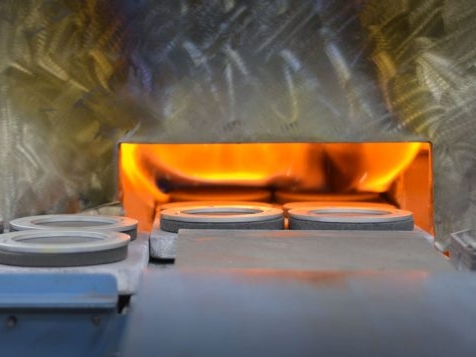
Sintering is where the magic happens. Green parts are heated in a controlled-atmosphere furnace to temperatures below the metal’s melting point — typically 70–90% of the absolute melting temperature.
During sintering:
- Neck formation — Particles bond at contact points through solid-state diffusion.
- Densification — Pores shrink and the part gains mechanical strength and hardness.
- Alloying completes — Diffused elements fully integrate into the material matrix.
Furnace atmospheres (endothermic gas, nitrogen-hydrogen mix, or vacuum) prevent oxidation and control carbon content. The sintering cycle — temperature, hold time, and cooling rate — is precisely engineered for each material system.
After sintering, parts typically achieve 90–98% of wrought density, with corresponding improvements in tensile strength, ductility, and fatigue resistance.
Step 5: Secondary Operations
Many PM parts receive post-sintering treatments to meet specific performance requirements:
- Sizing / Coining — Precision re-pressing for tight dimensional tolerances.
- Impregnation — Porosity is filled with oil (for self-lubricating bearings) or resin (for improved machinability).
- Heat Treatment — Quenching, tempering, or case hardening to increase hardness and wear resistance.
- Surface Finishing — Plating, coating, shot peening, or deburring.
- Machining — Drilling, tapping, or turning features that cannot be formed during compaction.
- Steam Treatment — Creates a protective oxide layer on ferrous parts for corrosion resistance.
Key Advantages of Powder Metallurgy
表格
| Benefit | Description |
|---|---|
| Material Efficiency | Up to 97% material utilization — minimal scrap compared to machining |
| Complex Geometries | Multi-level parts, splines, and intricate features formed in a single press cycle |
| Consistency | High repeatability for mass production with tight part-to-part tolerance |
| Cost-Effective | Lower per-unit cost at high volumes; eliminates many machining steps |
| Tailored Properties | Controlled porosity for filters, bearings, or lightweight structural parts |
| Alloy Flexibility | Can produce materials and composites difficult to manufacture by casting |
Common Applications
- Automotive — Transmission gears, connecting rods, valve seats, camshaft lobes, and bearing caps
- Aerospace & Defense — Lightweight structural components, filter elements, and friction materials
- Medical & Dental — Surgical instruments, implant components, and orthopedic parts using biocompatible alloys
- Electronics — Heat sinks, contact materials, EMI shielding, and magnetic components
- Industrial — Self-lubricating bearings, gears, sprockets, and tooling components