
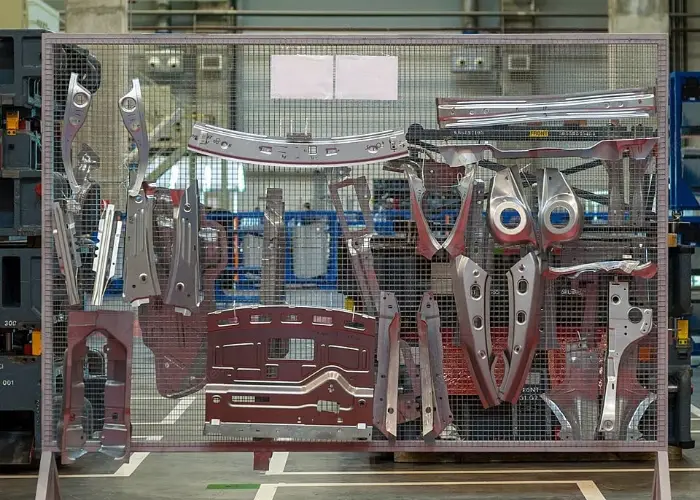
Metal stamping stands as one of the most foundational and indispensable manufacturing technologies in the global automotive industry. Serving as the backbone of vehicle structural and exterior production, this cold-forming process shapes flat metal sheets into precise, high-strength components through blanking, bending, embossing, and hot stamping. From traditional internal combustion engine (ICE) vehicles to modern electric vehicles (EVs), metal-stamped parts dominate over 60% of a vehicle’s total metal components. While the core manufacturing principle remains consistent, the material selection, structural design, performance standards, and process specifications of stamped components differ drastically between EVs and conventional ICE vehicles, driven by evolving industry demands for lightweighting, energy efficiency, safety, and thermal management.
Core Role of Metal Stamping in Traditional ICE Vehicles
For decades, metal stamping has optimized the manufacturing efficiency and structural reliability of traditional gasoline and diesel vehicles. ICE vehicles feature complex powertrain systems, including engines, fuel tanks, exhaust systems, and transmission assemblies, which define the core requirements of their stamped components: structural rigidity, vibration resistance, heat resistance, and cost-effectiveness.
The most common stamped parts for traditional vehicles cover three major categories. First, body exterior and structural panels, including door panels, hoods, roofs, fenders, and body frame reinforcements. These components primarily use low-carbon steel and conventional high-strength steel, balancing moldability, surface finish, and collision safety. Second, chassis and powertrain stamped parts, such as suspension brackets, engine mounts, and chassis cross beams, which require excellent fatigue resistance to withstand long-term mechanical vibration and load impact. Third, functional auxiliary parts, including fuel tank shells, exhaust pipe brackets, and interior metal structural parts, focus on corrosion resistance and dimensional stability.
Traditional automotive stamping prioritizes mature, high-volume production processes. Standard cold stamping technology with ordinary steel materials meets the cost-control and mass-production needs of conventional vehicles. The industry’s long-term iteration has formed a highly standardized production system, ensuring stable component consistency and low manufacturing costs for ICE vehicles.
EV Metal Stamping: New Requirements and Specialized Components
The rapid expansion of the electric vehicle market has reshaped the automotive metal stamping landscape. According to industry market data, the global EV metal stamping market maintains a compound annual growth rate of 12.8%, with market scale expected to exceed $21 billion by 2034, far outpacing the growth of traditional ICE vehicle stamping segments. Unlike ICE vehicles, EVs eliminate bulky engine and exhaust systems but introduce core assemblies such as battery packs, electric motors, and high-voltage electrical systems, bringing revolutionary changes to stamping component design and process standards.
EV stamping design centers on two core goals: extreme lightweighting to extend cruising range and high safety and thermal stability to protect electrical systems. To achieve lightweighting, manufacturers widely adopt advanced high-strength steel (AHSS), ultra-high-strength hot-stamped steel (such as 22MnB5), and lightweight aluminum alloys, replacing traditional ordinary steel. These materials significantly reduce vehicle body weight while ensuring structural strength, directly improving EV energy efficiency and battery life.
Beyond conventional body and chassis parts, EVs require a large number of exclusive stamped components that do not exist in traditional vehicles. The most critical ones include precision-stamped battery housing shells, battery tray reinforcing beams, motor mounting brackets, and thermal management system structural parts. These components demand ultra-high dimensional accuracy, sealing performance, and thermal fatigue resistance. For example, battery tray stamped parts must resist deformation during vehicle driving and isolate external temperature changes to ensure battery pack safety and stability. In addition, electrical steel stamping for EV motors requires strict fatigue strength control under high-temperature and high-load operating conditions to guarantee long-term motor service life.
Key Process Differences Between EV and Traditional Automotive Stamping
The divergent performance requirements of the two vehicle types lead to obvious differences in stamping processes, material applications, and quality control standards.
1. Material Iteration Upgrade
Traditional vehicle stamping relies heavily on low-cost, easy-to-form mild steel, with low requirements for material strength and lightweight performance. In contrast, EV stamping extensively applies hot-stamped ultra-high-strength steel and pre-hardened aluminum alloy materials. Although these materials have higher strength and lighter weight, they feature poor formability and high springback, putting forward higher requirements for stamping process precision and mold design.
2. Process Technology Innovation
Traditional automotive stamping is dominated by conventional cold stamping processes with mature and simple production flows. EV manufacturing widely adopts hot stamping technology for ultra-high-strength steel forming. The hot stamping process heats the steel sheet to a high temperature for forming and rapid quenching hardening, which solves the forming difficulty of high-strength steel and achieves ultra-high structural strength (tensile strength up to 1.5–2.0 GPa), perfectly matching EV body safety and lightweighting needs. Meanwhile, computer simulation-assisted stamping process design has become a standard procedure for EV precision parts production, effectively optimizing mold structure and forming parameters to reduce defects .
3. Quality Control Standards
EV-stamped components, especially battery and motor system parts, have stricter tolerance control, flatness, and structural stability requirements than traditional vehicle parts. Slight dimensional deviation or structural deformation may affect battery assembly accuracy and electrical system safety. Therefore, EV stamping production requires higher-precision mold processing, stricter process monitoring, and more rigorous finished product testing.
Future Trends of Automotive Metal Stamping
As the global automotive industry fully transitions to electrification and intelligentization, metal stamping technology is undergoing continuous upgrading and iteration. On the one hand, lightweight material stamping technology will continue to be optimized. The application of new hot stamping die steels and aluminum alloy pre-hardening forming technology will further improve the forming quality and production efficiency of high-performance lightweight parts. On the other hand, intelligent stamping manufacturing, represented by simulation optimization and precision mold technology, will realize full-process digital control, reducing production costs while improving product consistency.
For traditional vehicles, stamping technology will continue to focus on cost optimization and standardized mass production, while gradually absorbing lightweight process technologies to meet increasingly stringent fuel consumption and emission standards. For EVs, customized precision stamping for battery and electrical system components will become the core development direction, driving the continuous innovation of automotive stamping materials and processes.
Academic References & Technical Resources
1. SAE Mobilus. Stamping Process Research on Electrical Steel Fatigue Performance for EV Motors.
2. Atlantis Press. Research and Application of New High-Performance Hot Stamping Die Steel.