

A quotation tells you what a supplier is offering. It does not, by itself, show whether the supplier understands the drawing, can document the critical features, or will control changes after you approve the sample. Qualifying a CNC machining supplier in China means testing those points with evidence tied to your part.
Start with a small, controlled evaluation. Keep the drawing revision, material requirements, acceptance criteria, and quotation scope consistent across suppliers. Otherwise, you may be comparing different offers while assuming the lowest unit price is the best choice.
Ask for evidence that resembles your part
Match the enquiry to the work involved: turned shafts, multi-face housings, thin sections, threaded features, or visible finished surfaces. Ask what aspects need review and what information is missing. A relevant discussion of access, workholding, finishing, or inspection is more useful than an unsupported statement that every part can be made.
Request only information the supplier is permitted to share. An anonymized inspection example or authorized component photograph can be useful. Another customer’s confidential drawing should not be required to prove competence.
Check the identity and scope behind the claim
Confirm the legal company name, quotation entity, manufacturing location, and contact responsible for technical questions. Where a certificate matters to your purchasing requirements, check the named organization, scope, expiry, and issuing body. A logo on a website does not establish that your intended process is within the certified scope.
Clarify which operations will be performed at the proposed facility and which will involve another provider. If heat treatment, plating, or testing is external, agree how the supplier controls requirements and retains records. An external operation should be disclosed and controlled rather than discovered after delivery.
Use the trial order to test a defined scope
| Evaluation point | Ask before ordering | Check when the trial arrives |
|---|---|---|
| Drawing control | Which revision is quoted, and which exceptions remain open? | Part and report identification match the approved revision. |
| Material | Which grade, condition, and documentation are included? | Records correspond to the supplied material and agreed traceability. |
| Critical features | Which characteristics are checked, by what method and sampling scope? | Results address those characteristics; investigate unexplained differences. |
| Appearance | Which surfaces are visible, and what defines acceptance? | Finish, handling damage, and packaging satisfy the agreed criteria. |
| Commercial scope | What tooling, finishing, documents, freight, and exclusions are included? | Delivery contents and charges match the accepted quotation. |
Read inspection records as evidence, not decoration
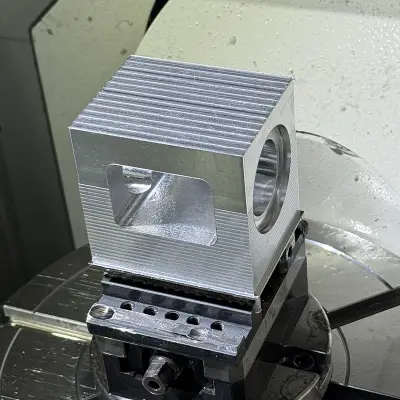
A report is useful when its results can be connected to the drawing and the supplied parts. Check the part number, revision, characteristic identification, units, measured values, acceptance limits, and relevant inspection information. Clarify whether it covers all parts, selected samples, or only specified features.
If incoming results disagree, compare the reference setup, measured characteristic, part condition, and method before deciding that either reading is automatically correct. Keep the physical parts and records identified while the discrepancy is investigated.
NIST’s work on manufacturing-data traceability supports the importance of preserving trustworthy links between requirements and records. It does not endorse any particular supplier or replace your qualification procedure.
Define what happens after the sample is approved
Record the approved revision and outstanding actions. Specify which substitutions or changes require permission, including material changes, altered finishing scope, or proposed changes to an agreed manufacturing or inspection route. Agree how parts and records will be identified on repeat orders.
Do not interpret a small successful trial as proof of stable performance at every quantity. Review repeat orders for delivery, documentation, defects, responsiveness, and corrective actions. Your purchasing team should decide which checks remain necessary as the relationship develops.
Compare suppliers on the same purchasing basis
Use a short scorecard built around the actual project: technical understanding, evidence quality, declared exceptions, trial results, communication, and total delivered scope. Weight these factors according to the cost of failure in your assembly. Do not borrow arbitrary weights simply because they appear in a procurement template.
Related resources: CNC machining RFQ checklist and custom CNC machining services.
Reference
NIST: Recommendations on Ensuring Traceability and Trustworthiness of Manufacturing-Related Data. The qualification checklist above is practical purchasing guidance, not a claim that NIST certifies suppliers.