
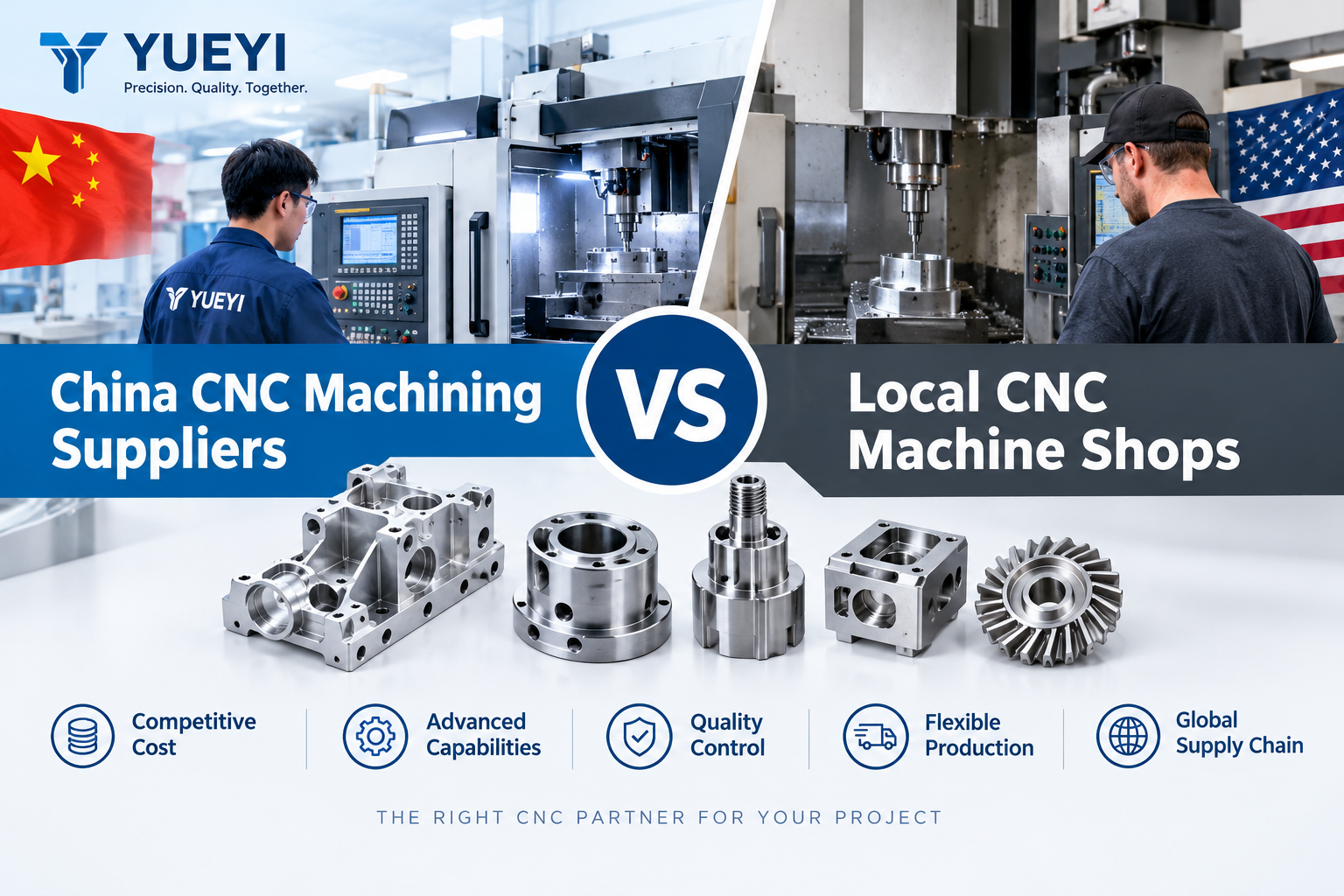
China CNC Machining Suppliers vs. Local CNC Shops: Which Is Right for Your Project?
When sourcing custom CNC machined parts, manufacturers and procurement teams often face an important question: Should you work with a local CNC machine shop or choose a CNC machining supplier in China?
For many years, the decision was mainly based on price and geographical distance. Local machining companies were considered easier to communicate with and faster for urgent jobs, while Chinese manufacturers were mainly associated with lower manufacturing costs.
Today, the situation is more complicated.
China has developed a mature manufacturing ecosystem covering CNC machining, precision inspection, surface treatment, heat treatment, tooling, assembly, and logistics. At the same time, local CNC shops remain an important option for projects requiring extremely short delivery times, local collaboration, or specific regulatory requirements.
So, which option makes more sense for your project?
The answer depends on your part complexity, production volume, quality requirements, delivery schedule, and total manufacturing cost.
In this article, we compare China CNC machining suppliers with local CNC machine shops and explain the key factors you should consider before making a sourcing decision.
5 Reasons to Consider a China CNC Machining Supplier
Chinese CNC manufacturers can provide several advantages for companies sourcing precision components internationally.
The main benefits are usually related to:
- Competitive manufacturing costs
- Advanced CNC machining capabilities
- Strong manufacturing supply chains
- Flexible production volumes
- Integrated quality control and finishing services
Let’s take a closer look.
1. Competitive Total Manufacturing Cost
One of the main reasons companies consider Chinese CNC machining suppliers is cost efficiency.
However, the real advantage is not simply a lower hourly machining rate.
China has a large and mature manufacturing supply chain for materials, cutting tools, fixtures, heat treatment, surface finishing, inspection, packaging, and logistics.
This can help reduce the overall cost of producing a finished component.
Material sourcing
Common engineering materials such as:
- Aluminum 6061 and 7075
- Stainless steel 303, 304 and 316
- Carbon steel
- Tool steel
- Titanium
- Copper and brass
- Engineering plastics
are widely available through China’s industrial supply network.
For production parts, access to multiple material suppliers can also make it easier to select a suitable material according to both technical requirements and budget.
Tooling and fixtures
Custom fixtures and machining aids are often required for complex CNC components.
A mature local manufacturing ecosystem makes it easier to design and manufacture fixtures, jigs, gauges, and other production tooling without sending them to multiple unrelated suppliers.
Surface treatment and secondary processes
CNC machining is often only one step in the manufacturing process.
A finished component may also require:
- Anodizing
- Electroless nickel plating
- Hard anodizing
- Powder coating
- Black oxide
- Passivation
- Heat treatment
- Carburizing
- Polishing
- Laser marking
- Deburring and cleaning
Coordinating these processes through an experienced manufacturing partner can reduce communication, transportation, and scheduling problems.
Therefore, when comparing suppliers, it is better to evaluate the total landed cost rather than comparing CNC machining hourly rates alone.
2. Advanced CNC Machining Capabilities
The capabilities of Chinese CNC manufacturers have developed significantly over the past decade.
Professional manufacturers now operate multi-axis machining centers, CNC turning centers, CMM inspection systems, wire EDM machines, grinding equipment, and other precision manufacturing equipment.
For complex components, 5-axis CNC machining can be particularly valuable.
Compared with conventional 3-axis machining, simultaneous 5-axis machining can reduce the number of setups required for complicated geometries.
This can help reduce:
- Repositioning errors
- Fixture requirements
- Setup time
- Dimensional variation between machining operations
At Yueyi Precision Technology, our manufacturing capabilities include CNC milling, CNC turning, 5-axis machining, precision inspection, wire cutting, fixtures, and other supporting processes.
Our factory information shows multiple 5-axis CNC machines and precision manufacturing equipment, supporting components used in industries including robotics, drones, medical equipment, yachts, and industrial equipment.
For customers with complex 3D components, this type of manufacturing capability can be especially useful.
3. From Prototypes to Small-Batch and Production Parts
A product rarely goes directly from CAD design to mass production.
A typical development process may look like:
Prototype → Design Validation → Small Batch → Production
Changing suppliers at every stage can create unnecessary engineering and quality risks.
For example, if the prototype is produced by one supplier and the production parts are manufactured by another, differences in machining methods, tooling, inspection procedures, or material sources may affect consistency.
Working with a manufacturer that can support both prototypes and production allows engineering feedback from the early stage to be carried into later production.
Yueyi provides precision machining services for prototypes, small-batch production, and larger production requirements, allowing customers to use one manufacturing partner as their projects develop.
This is particularly useful for:
- Robotics components
- Automation equipment
- Drone components
- Aerospace parts
- Industrial machinery
- Medical equipment
- Custom mechanical components
4. Precision Inspection and Quality Control
Cost is only one part of CNC sourcing.
For precision components, repeatability and inspection capability are equally important.
A professional CNC supplier should be able to control the complete manufacturing process rather than simply producing parts and checking a few dimensions at the end.
Depending on the component, inspection may include:
- CMM measurement
- Dimensional inspection
- Thread inspection
- Surface roughness inspection
- Hardness testing
- Visual inspection
- Material verification
- First article inspection
- Sampling inspection
Yueyi uses CMM inspection and other quality-control procedures to verify precision components before shipment. The company also states that its quality system includes internationally recognized certifications and inspection processes.
For customers purchasing precision parts internationally, inspection reports can provide additional confidence before the parts leave the factory.
5. One Manufacturing Partner for Multiple Processes
Another advantage of working with an experienced Chinese manufacturing supplier is process integration.
A typical CNC component may require:
CNC machining → Heat treatment → Grinding → Surface treatment → Inspection → Marking → Packaging
If every process is handled by a different supplier, your purchasing team must coordinate:
- Multiple quotations
- Different delivery schedules
- Quality issues
- Transportation between suppliers
- Technical communication
- Production changes
A capable manufacturing partner can coordinate these processes as part of one project.
This can make international sourcing much easier, especially when the parts have complex manufacturing requirements.
When Does a Local CNC Machine Shop Make More Sense?
China is not automatically the right solution for every project.
There are situations where working with a local CNC shop can be more practical.
1. Extremely Urgent Parts
If you need a component immediately for a machine breakdown or urgent prototype test, a local supplier may have an advantage.
For example, if a replacement component is required within 24–48 hours, international production and shipping may not fit the schedule.
For these situations, geographical proximity can be more important than unit price.
2. Face-to-Face Engineering Support
Some projects require engineers and machinists to work together physically.
If your engineering team needs to:
- Visit the machine shop frequently
- Modify the setup on-site
- Test assemblies together
- Solve manufacturing problems immediately
a local supplier can make this collaboration easier.
3. Regulatory or Data Restrictions
Certain industries have strict regulations concerning technical data, manufacturing locations, or supply chains.
Defense-related projects and some highly regulated applications may require domestic manufacturing or specific certifications.
In these cases, regulatory requirements should be checked before selecting an overseas supplier.
China CNC Supplier vs. Local CNC Shop
| Factor | Local CNC Machine Shop | China CNC Machining Supplier |
|---|---|---|
| Prototype production | Suitable | Suitable |
| Small-batch production | Suitable | Suitable |
| Medium-volume production | Depends on capacity | Often highly flexible |
| Manufacturing cost | Generally higher | Often more competitive |
| Local communication | Very convenient | Remote communication required |
| Urgent 24–48 hour jobs | Advantage | International logistics required |
| 5-axis machining | Depends on supplier | Widely available from capable manufacturers |
| Material sourcing | Depends on local network | Broad manufacturing supply chain |
| Surface finishing | May require subcontracting | Often easier to coordinate through local suppliers |
| CMM inspection | Depends on equipment | Available from professional suppliers |
| Custom fixtures | Available | Highly developed supply chain |
| International shipping | Not required | Required |
| Production scalability | Depends on shop size | Strong for qualified manufacturers |
| Regulatory restrictions | Easier for domestic requirements | Project-dependent |
The table shows why there is no universal answer.
The right supplier depends on the requirements of your individual project.
What Should You Check Before Choosing a CNC Supplier?
Instead of choosing a supplier based only on price, procurement teams should evaluate several factors.
1. Machine capabilities
Check whether the supplier actually owns or controls the equipment required for your components.
For complex parts, ask about:
- 3-axis CNC
- 4-axis CNC
- 5-axis CNC
- CNC turning
- Wire EDM
- Grinding
- CMM inspection
2. Experience with your material
Machining aluminum is very different from machining hardened tool steel, titanium, stainless steel, or engineering plastics.
Ask the supplier about previous experience with your specific material.
3. Inspection capability
A supplier should have appropriate inspection equipment for the tolerance requirements of your drawings.
For high-precision components, CMM capability can be particularly important.
4. Manufacturing process
Ask how the supplier plans to manufacture the part.
A good quotation should not only contain a price. The engineering team should understand:
- Material
- Machining method
- Critical dimensions
- Tolerances
- Surface Treatment
- Heat treatment
- Inspection requirements
- Packaging
- Delivery requirements
5. Communication and project management
International manufacturing requires clear communication.
The supplier should be able to respond quickly to technical questions, clarify drawings, identify manufacturing risks, and provide production updates.
Why Choose Yueyi for CNC Machining in China?
Yueyi Precision Technology is a precision manufacturing company based in Dongguan, Guangdong, China.
We provide custom manufacturing services covering 5-axis CNC machining, CNC milling, CNC turning, precision machining, prototyping, fixtures, wire cutting, surface finishing, inspection, and production parts.
Our manufacturing experience includes precision components for:
- Humanoid robots
- Drones and UAVs
- Automation equipment
- Aerospace-related applications
- Medical equipment
- Industrial machinery
- Yachts and marine equipment
For complex components, our engineering team reviews drawings and 3D models before production to identify potential manufacturing issues.
Our process can cover:
Drawing Review → Engineering Analysis → CNC Machining → Secondary Processes → CMM Inspection → Final Inspection → Packaging → Delivery
Yueyi also operates manufacturing facilities in Dongguan with 5-axis CNC, 4-axis CNC, wire cutting, EDM, grinding, turning, stamping, laser cutting, and 3D printing equipment.
The goal is not simply to provide a low CNC machining price.
Our goal is to provide stable quality, reliable delivery, engineering support, and competitive total manufacturing cost for customers sourcing precision parts from China.
Final Thoughts: China CNC or Local CNC?
Choosing between a Chinese CNC machining supplier and a local CNC machine shop depends on your project’s priorities.
A local CNC supplier can be a practical choice when you need extremely fast turnaround, frequent on-site collaboration, or specific domestic regulatory compliance.
A professional China CNC machining supplier can be a strong option when you need competitive manufacturing costs, advanced machining capabilities, flexible production volumes, integrated secondary processes, and access to a mature manufacturing supply chain.
The most important point is to evaluate the supplier, rather than judging an entire country or region by price alone.
A reliable CNC machining partner should be able to demonstrate:
- Real manufacturing capabilities
- Experienced engineers
- Appropriate inspection equipment
- Stable quality control
- Clear communication
- Consistent delivery
- Experience with similar components
For companies looking for precision CNC machining in China, Yueyi can support projects from prototype development through small-batch and production manufacturing.
Have a CNC machining project? Send us your 2D drawings or 3D CAD files for an engineering review and quotation.