
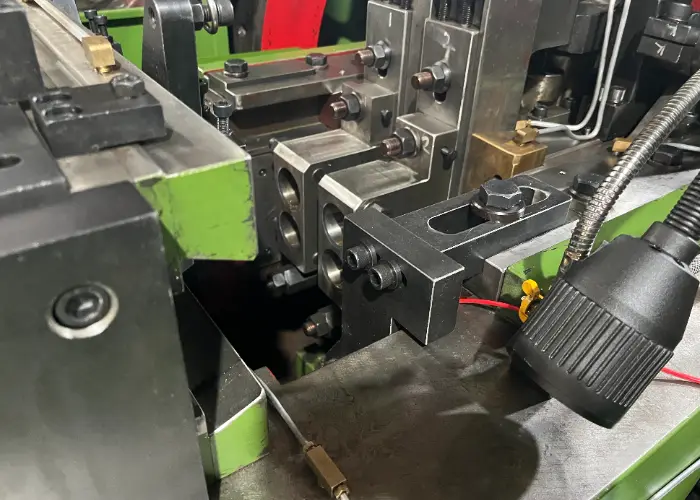
When manufacturing precision metal parts, fasteners, and mechanical components, manufacturers and procurement teams often face a critical decision: cold heading or CNC machining. Both metal fabrication methods are widely used in automotive, electronics, industrial machinery, and hardware industries, but they differ drastically in mechanical performance, production speed, material utilization, and overall manufacturing cost.
Choosing the wrong process can lead to higher production expenses, weaker part durability, longer lead times, or unnecessary material waste. To help you select the most cost-effective and high-quality solution for your project, this guide comprehensively compares cold heading vs CNC machining in terms of mechanical strength, production efficiency, manufacturing cost, material adaptability, and industrial application scenarios.
1. Basic Process Principles
What is Cold Heading?
Cold heading (cold forging) is anon-cutting metal forming process that reshapes metal wire or rod blanks at room temperature through high-pressure extrusion and impact molding. Instead of removing excess material, cold heading deforms metal plastically to form near-net-shape parts. It preserves complete metal fiber flow lines and is designed for high-volume symmetrical component production.
What is CNC Machining?
CNC machining is a subtractive manufacturing process. Using 3-axis or 5-axis CNC equipment, operators cut, mill, drill, and tap solid metal blanks to remove redundant materials and obtain precise part shapes. CNC machining relies on digital programming and features ultra-high dimensional flexibility, suitable for complex, irregular, and low-batch custom parts.
2. Mechanical Strength Comparison (Core Difference)
Mechanical performance is the biggest advantage of cold heading over traditional CNC machining, especially for load-bearing fasteners and structural components.
Cold Heading: Higher Structural Strength & Fatigue Resistance
During cold heading forming, the metal fiber structure is continuously stretched, compacted, and intact without being cut off. The dense molecular arrangement significantly improves the part’s tensile strength, hardness, impact resistance, and fatigue life. Cold-headed fasteners can withstand long-term high-load operation and are less likely to deform or fracture under dynamic pressure.
CNC Machining: Stable but Weaker Structural Toughness
CNC cutting directly severs the original metal fiber flow, resulting in discontinuous internal structure. Although CNC parts achieve high dimensional accuracy, their overall toughness and fatigue resistance are lower than cold-headed counterparts. Under long-term vibration and high-pressure working conditions, CNC-machined fasteners are more prone to metal fatigue and damage.
Conclusion: For high-strength automotive fasteners, chassis bolts, and mechanical positioning pins, cold heading is far more reliable.
3. Production Efficiency Comparison
Cold Heading: Ultra-High Speed for Mass Production
Automated multi-station cold heading machines support continuous cyclic production, manufacturing hundreds of parts per minute. The one-time forming process requires no repeated clamping or secondary programming, delivering extremely high output consistency. For standardized symmetrical parts like screws, bolts, and rivets, cold heading efficiency is 30–50 times higher than CNC machining.
CNC Machining: Low Efficiency for Large Batches
CNC machining requires independent programming, tool setting, clamping, and cutting for each batch. A single standard bolt may take several minutes to process. When facing large orders of thousands or tens of thousands of pieces, CNC production cycles are long and cannot meet rapid delivery requirements.
Conclusion: Cold heading dominates high-volume mass production; CNC machining is only suitable for small-batch and prototype production.
4. Manufacturing Cost Comparison
Cold Heading: Low Unit Cost, Zero Material Waste
- Material cost: Cold heading achieves nearly 100% material utilization with no metal scraps, greatly saving raw material expenses, especially for stainless steel, brass, and aluminum alloys.
- Labor & time cost: Fully automated production requires minimal manual intervention and shortens delivery cycles.
- Processing cost: Although cold heading requires initial mold investment, the average unit cost drops sharply after mass production.
CNC Machining: High Comprehensive Cost
- Material waste: Subtractive cutting produces 20%–40% metal scrap, causing serious material loss.
- Equipment consumption: Tool wear, electricity consumption, and manual programming labor costs remain high for every batch.
- Unit price: For bulk orders, CNC unit prices are 2–4 times higher than cold heading parts.
Conclusion: Cold heading has absolute cost advantages for mass production; CNC is cost-effective only for small-batch customized parts.
5. Precision & Dimensional Flexibility
Cold Heading: High Consistency, Limited Shape Flexibility
Cold heading relies on precision mold forming, ensuring excellent batch consistency and stable tolerance control. However, it is only suitable for symmetrical, regular, and simple structural parts. Complex curved surfaces, irregular grooves, and special-shaped structures cannot be completed by cold heading alone.
CNC Machining: Unlimited Structural Flexibility, Ultra-High Precision
3-axis and 5-axis CNC machining can process almost all complex geometries, including irregular cavities, special thread structures, and asymmetric parts. It supports ultra-tight tolerance control and is the best choice for customized non-standard parts with complex requirements.
6. Material Adaptability
Cold Heading: Strictly requires ductile materials, including carbon steel, stainless steel, brass, and aluminum. Brittle materials cannot withstand high-pressure extrusion and will crack during forming.
CNC Machining: Compatible with almost all metal and plastic materials, including high-hardness alloy steel, titanium alloy, and brittle materials that cannot be cold-formed.
7. Industrial Application Scenarios
Choose Cold Heading If Your Project Is:
- Mass production of standard fasteners: bolts, screws, rivets, pins, studs
- Automotive, new energy, and 3C electronic lightweight symmetrical parts
- Projects requiring high structural strength, fatigue resistance, and low unit cost
Choose CNC Machining If Your Project Is:
- Small-batch prototypes, customized non-standard parts
- Complex irregular structures, precision cavity parts, and special-shaped components
- High-precision mold parts, medical equipment, and aerospace components
8. Best Industrial Combination: Cold Heading + CNC Secondary Machining
In modern precision manufacturing, the most efficient solution is combining the two processes. Manufacturers use cold heading to complete fast blank mass production to ensure high strength and low cost, then adopt CNC precision secondary machining to finish grooves, holes, special threads, and tolerance calibration. This hybrid method perfectly balances strength, precision, efficiency, and cost.