
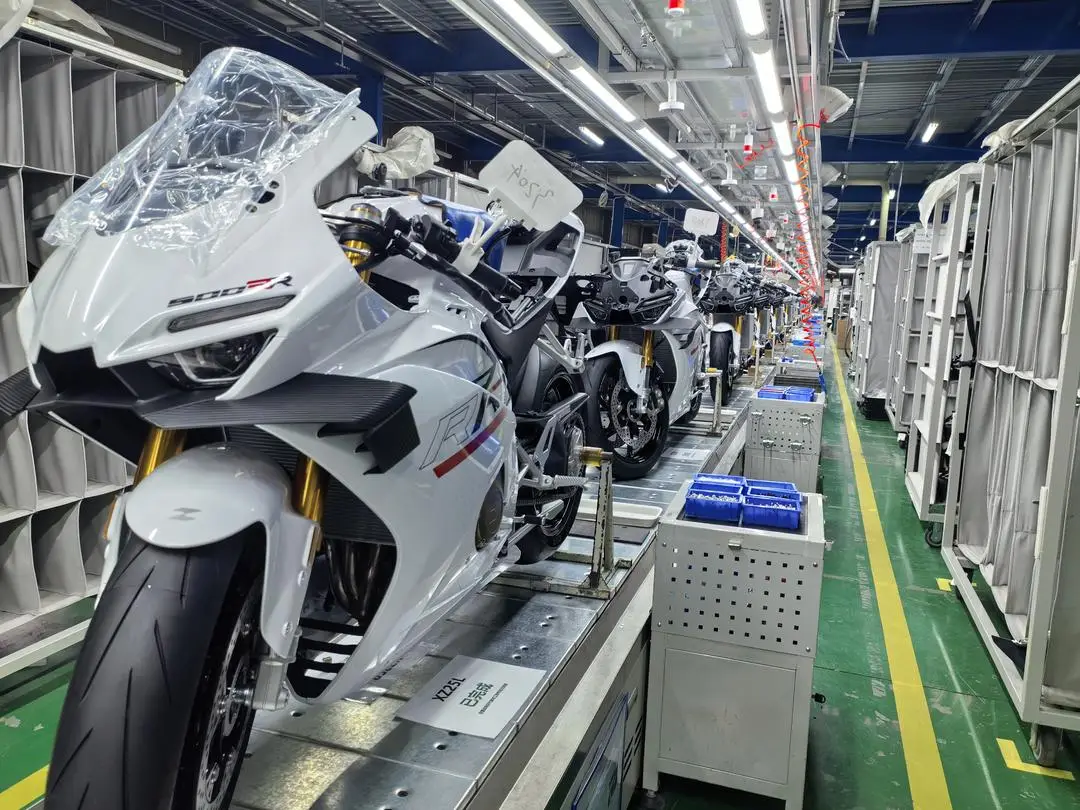
From the racetrack to mass production, the improvement of motorcycle performance relies heavily on high-precision manufacturing processes. ZXmoto secured its sixth championship win of the season. Behind this achievement are not only the rider’s strength and the team’s precise tuning, but also the important role of CNC machining in enhancing the precision, strength, and lightweight performance of key motorcycle components.
1. Precision manufacturing of Engine and Transmission Components
Motorcycle engines have high requirements for dimensional accuracy, surface finish, and assembly consistency. CNC machining is commonly used for:
- Cylinder heads and cylinder blocks
- Crankcases and gearbox housings
- Clutch housings
- Intake and exhaust ports
- Gears and shaft components
- Camshaft-related components
For example, the combustion chamber, valve seat holes, and intake and exhaust passages on a cylinder head all require high-precision machining. CNC ensures stable and consistent dimensions for every component.
2. Precision manufacturing of Frames and Structural Components
Some high-end motorcycles and racing motorcycles make extensive use of CNC-machined structural components, such as:
- Aluminum alloy frame connectors
- Rear swingarm components
- Triple clamps / upper and lower yokes
- Footpeg brackets
- Engine mounts
- Suspension linkage components
These parts usually require high strength and low weight. CNC machining can be combined with materials such as aluminum alloy and titanium alloy to achieve lightweight design.
3. Brake and Suspension System Components
The braking and suspension systems of motorcycles have very high safety requirements. CNC machining is commonly used for:
- Brake calipers
- Brake disc carriers
- Front fork triple clamps
- Suspension adjustment knobs
- Wheel hubs
- Bushings and connecting mounts
Especially on high-performance motorcycles, many brake, suspension, and wheel hub components are CNC-machined from aluminum alloy to improve strength and precision.
4. Appearance and Custom Parts
CNC machining is also very common in the motorcycle customization market, including:
- CNC brake levers and clutch levers
- Mirror brackets
- Fuel tank caps
- Footpegs and side stands
- Handlebar clamps
- Frame sliders and crash protection mounts
- Chain adjusters
- License plate holders
These parts often emphasize appearance, texture, and personalization. CNC machining can create effects such as anodizing, brushed finishes, chamfered edges, and polished highlights.
5. Mold and Fixture Manufacturing
Even when the final parts are not directly produced by CNC machining, CNC is often used to manufacture production tools, such as:
- Casting molds
- Stamping dies
- Injection molds
- Welding fixtures
- Inspection gauges
- Assembly positioning fixtures
Many plastic fairings, light housings, instrument housings, rubber parts, and other motorcycle components rely on CNC-machined molds.
6. Prototype Development and Small-Batch Trial Production
During the development of new motorcycle models, CNC Precision manufacturing is especially important. It can quickly produce prototype parts to verify:
- Whether the component structure is reasonable
- Whether the installation position is accurate
- Strength and interference issues
- Appearance proportions
- Ergonomic design
Compared with mold making, CNC Precision manufacturing is more suitable for the trial production stage, because modified designs can be quickly re-machined.
7. Lightweight and High-Performance Components
High-end street bikes, sport bikes, off-road motorcycles, and racing motorcycles often use CNC Precision manufacturing to produce lightweight components. Through hollowing, weight-reduction grooves, topology optimization, and other design methods, weight can be reduced while maintaining strength.
Common materials include:
- 6061 aluminum alloy
- 7075 aluminum alloy
- Titanium alloy
- Stainless steel
- Magnesium alloy
- Aluminum materials for carbon fiber molds
8. Advantages of CNC Precision manufacturing
In motorcycle manufacturing, the main advantages of CNC Precision manufacturing include:
- High precision
- Good repeatability
- Suitable for complex curved surfaces and irregular structures
- Capable of machining high-strength materials
- Suitable for small-batch and high-end components
- Fast for model updates and prototype production
- Excellent appearance and surface quality
9. Limitations
CNC Precision manufacturing is not suitable for every type of component:
- For simple parts in large-scale production, the cost may be higher than stamping or die casting
- Machining time is relatively long
- Material waste is relatively high
- Complex parts require advanced programming and fixture design
- Equipment and cutting tool costs are high
Therefore, in mass-produced motorcycles, CNC machining is usually used for high-precision key components, molds, fixtures, prototype parts, and high-end custom parts. For large-volume parts, processes such as die casting, forging, stamping, and injection molding are often used together.
In one sentence: CNC makes motorcycle component manufacturing more precise, lighter, and better suited for complex structures and high-end customization. It is an important process in the production of engines, frames, braking systems, suspension systems, and custom motorcycle parts.