Definition
Aluminum anodizing, also known as anodic oxidation, is an electrochemical surface treatment exclusive to aluminum materials. Different from electroplating that attaches foreign metal coatings onto workpieces, this process electrochemically transforms the surface layer of aluminum substrate into integrated hard aluminum oxide film. The oxide layer bonds tightly with the base aluminum and will never peel or flake off.
Working Principle
- The aluminum workpiece is connected as the anode (positive electrode) and placed into a dilute acid electrolyte tank, with direct current applied.
- Water electrolysis occurs under electric current, and oxygen ions combine with aluminum atoms on the part surface.
- Chemical reaction formula: \(2Al + 3H_2O \rightarrow Al_2O_3 + 6H^+ + 6e^-\)
- The generated porous oxide film grows both inward into the aluminum matrix and outward on the surface. The tiny pores allow subsequent dyeing and sealing treatment.
Standard Technological Flow
- Degreasing: Remove cutting fluid, oil stains and fingerprint residues with alkaline cleaning agents.
- Caustic Etching: Treat the workpiece in caustic soda solution to obtain matte texture and eliminate extrusion marks and casting defects.
- Desmutting: Clean black silicon ash produced after alkaline etching via nitric acid neutralization.
- Anodizing: Conduct oxidation in sulfuric acid tank under controlled voltage and temperature to form oxide film with specified thickness.
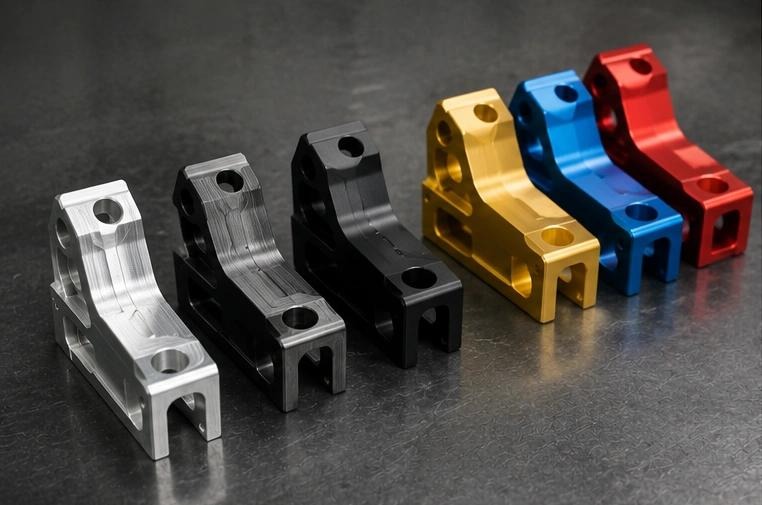
- Dyeing (Optional): Infuse organic colorants into the porous oxide layer to form colors including black, silver, gold, blue, red and gray.
- Sealing: Seal the micro pores to lock in color and greatly improve corrosion and wear resistance; common methods include hot water sealing and nickel acetate sealing.
- Drying: Complete post-process dehydration.
Main Classification of Anodizing Processes
Type I: Chromic Acid Anodizing
- Electrolyte: chromic acid
- Film thickness: 0.5–3μm, relatively low wear resistance
- Little impact on material fatigue performance, once applied to thin aerospace aluminum sheets
- Rarely used at present due to toxic hexavalent chromium pollution
Type II: Decorative Sulfuric Acid Anodizing (Most Widely Used)
- Electrolyte: diluted sulfuric acid
- Film thickness: 5–18μm
- Available in matte or bright metallic finishes, supports full-spectrum color dyeing
- Typical applications: consumer electronic housings, hardware accessories, auto decorative trims, CNC machined parts and aluminum frames
Type III: Hard Coat Anodizing
- Low-temperature sulfuric acid electrolyte with higher operating voltage
- Thick compact oxide layer ranging from 20μm to 100μm
- Ultra-high surface hardness (HV 400–600), outstanding friction resistance
- Natural gray-black base tone with limited color options
- Typical applications: hydraulic components, mechanical gears, fixture plates, medical devices and aerospace wear-resistant parts
Special Type: Clear Anodizing
Transparent undyed oxide film, retains the original metallic luster of aluminum and provides anti-corrosion protection without pigmentation.
Core Advantages
- Excellent corrosion resistance The sealed anodic film isolates moisture and oxygen, delivering far better anti-rust performance than raw aluminum in humid and coastal environments.
- Great scratch and wear resistance Hard anodized surfaces outperform powder coating and painting in anti-friction performance.
- Permanent metallic coloring Colorants are embedded inside oxide pores, resistant to chipping, peeling and fading.
- Electrical insulation property Aluminum oxide film serves as dielectric layer, ideal for insulating electronic components.
- Stable dimensional accuracy Half of the oxide film grows inward into the substrate, causing minimal dimensional change, which meets tolerance requirements of precision CNC parts.
- Food-safe and eco-friendly Free of heavy metal coatings, compliant with food contact and medical industry standards.
- Preserve original metallic texture Retain genuine metal texture, unlike plastic-looking paint finishes.
Disadvantages & Limitations
- Alloy composition influences surface effect: aluminum alloys with high silicon content result in dark and uneven anodized surfaces.
- Thin oxide film cannot cover deep scratches on the base aluminum material.
- Hard anodizing slightly reduces aluminum ductility; thin structural parts need fatigue performance verification.
- Thread sizes need pre-size adjustment because the oxide film adds surface thickness.
- Only applicable to aluminum and aluminum alloys; unavailable for steel, copper, brass and other metals.
Industrial Application Scenarios
- Consumer electronics: mobile phone middle frames, laptop casings, camera components
- Precision CNC machining: automation jigs, equipment housings
- Medical equipment: surgical aluminum accessories, auxiliary implant parts
- Automotive industry: decorative trim, pistons, valve wear-resistant components
- Aerospace & defense: lightweight structural aluminum parts
- Daily hardware: aluminum profiles, kitchen cookware, bicycle frames
Performance Comparison with Other Aluminum Surface Finishes
| Treatment Process | Hardness | Corrosion Resistance | Color Range | Risk of Peeling |
|---|---|---|---|---|
| Decorative Anodizing | Medium | Excellent | Full range | None |
| Hard Coat Anodizing | Very High | Outstanding | Limited | None |
| Powder Coating | Medium | Very Good | Full range | Possible |
| Electroplating | Medium | Good | Limited | High |
| Polished Raw Aluminum | Low | Poor | Silver only | N/A |
Short Version for Business Communication
Aluminum anodizing is a unique electrochemical surface finishing process for aluminum. It generates an inseparable anti-corrosion and wear-resistant aluminum oxide film on aluminum surfaces, without coating peeling issues.
Two mainstream types are decorative sulfuric anodizing (for colored appearance parts) and hard coat anodizing (for wear-resistant mechanical parts). The complete process includes degreasing, etching, anodizing, dyeing and sealing. It features anti-corrosion, scratch resistance, insulation and long-lasting metallic texture, widely adopted on CNC precision machined parts, electronics, medical hardware, auto and aerospace aluminum components.